



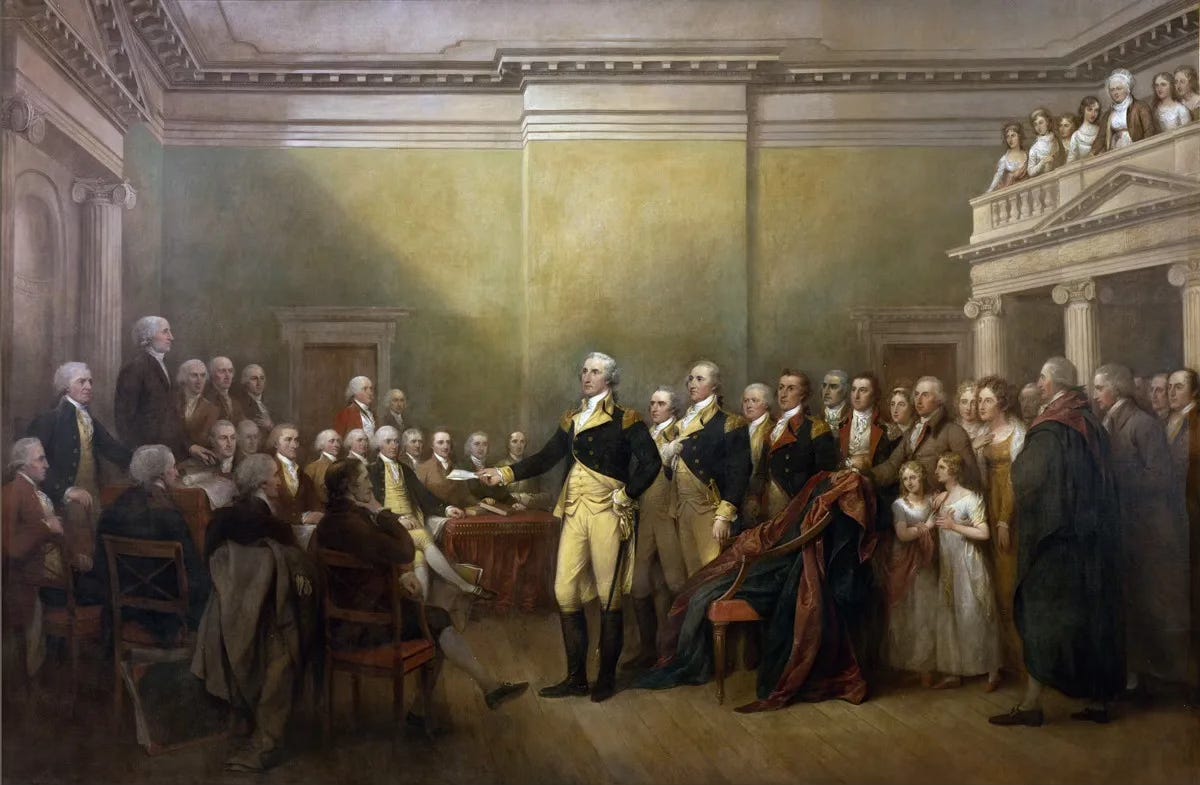
This Day in Legal History: The First Executive Department
On July 27, 1789, President George Washington signed the act establishing the Department of Foreign Affairs—the first executive department created under the brand-new Constitution, and the direct ancestor of today’s State Department, which was renamed a few weeks later. It’s easy to overlook, but this was a foundational moment: the First Congress was building the executive branch essentially from scratch, deciding what federal administration would actually look like in practice.
The most consequential part of the debate wasn’t the department’s diplomatic functions—it was a question that still echoes through constitutional law today: who controls the officials who run these departments? The Constitution says the President appoints principal officers with the Senate’s consent, but it is conspicuously silent on who can remove them. As Congress drafted the statute, it confronted this head-on in what historians call the “Decision of 1789.” After intense debate, Congress structured the law to reflect the view that the President alone—without needing the Senate’s permission—holds the power to remove the department head. That choice embedded a powerful assumption about presidential control of the executive branch into the very first agency Congress built.
The significance of July 27, 1789 reaches all the way to the present. The Decision of 1789 has been cited by the Supreme Court for a century as evidence that the Constitution vests the President with broad removal power—in cases like Myers v. United States, and more recently in the modern fights over the independence of agencies like the Consumer Financial Protection Bureau and the removal of officials at supposedly independent commissions. Every time we argue about whether a president can fire the head of an agency at will, we are arguing about a question the First Congress thought it had answered when it created this very first department. It’s a reminder that the architecture of executive power was contested from the founding’s opening days—and that those early choices still bind us.
A federal appeals court has refused to let the administration implement President Trump’s executive order overhauling mail-in voting, keeping the order frozen ahead of November’s midterm elections. In a 2-1 decision, the Boston-based First Circuit declined to lift an injunction that Democratic-led states won on June 25, when a lower-court judge found key parts of the order unconstitutional. Here’s what the March order actually did. It directed federal officials to build a national “state citizenship list” of eligible voters, and told the Justice Department to investigate officials who mail ballots to people the administration deems ineligible. The constitutional problem is structural: under the Constitution, the authority to set the “times, places and manner” of elections rests with the states and with Congress—not with the President acting alone by executive order. The states argued, and the courts have so far agreed, that the President can’t unilaterally rewrite the machinery of federal elections. This fits a pattern we’ve tracked all month—the SAVE citizenship database fight, the Justice Department’s warnings to election officials, the gutting of the Election Assistance Commission. The significance is that the judiciary is repeatedly drawing the same line: however much a president wants to reshape how Americans vote, elections in this country are decentralized by constitutional design, and that design is holding, at least for now, right when it matters most.
US appeals court rules Trump cannot implement mail-in voting order | Reuters
Tom Goldstein—one of the most celebrated Supreme Court advocates of his generation, who argued 44 cases before the Court and co-founded SCOTUSblog—has been sentenced to six years in prison for tax evasion and mortgage fraud. We previewed the sentencing on Friday; now the number is in: 72 months, and the judge revoked his bond and took him into custody on the spot. Recall the conduct the jury found: Goldstein concealed millions in winnings and losses from his secret life as an ultra-high-stakes poker player, diverted his law firm’s legal fees into personal accounts to cover gambling debts, and steered money to his creditors so it never surfaced as reportable income. The Justice Department had asked for eight years; the judge landed at six. The significance is the same point I made in my Forbes piece last week, now delivered with a prison term attached: the tax laws reach even the most sophisticated players, but only when the government invests the resources to untangle complex, deliberately obscured finances. Goldstein’s case is the rare, resource-intensive prosecution that actually happens—and its severity sends a message to the sliver of high-end taxpayers who assume complexity is a shield. That a lawyer who reached the absolute summit of the profession is now headed to federal prison over how he handled his taxes is a stark bookend to a remarkable career.
Star US Supreme Court lawyer Goldstein sentenced for tax crimes | Reuters
And finally, the same Boston appeals court has rejected the administration’s bid to revive its $100,000 fee on new H-1B visas for highly skilled foreign workers. The First Circuit declined to pause a lower-court ruling from June 8 that struck down the fee, and the reasoning goes to the heart of who gets to impose costs like this. The trial court held that the fee was, in substance, an unlawful tax that Congress never authorized—and taxing is a power the Constitution gives to Congress, not the executive. To put the number in perspective: employers seeking an H-1B visa typically paid somewhere between $2,000 and $5,000 in fees before this; the administration wanted to charge a hundred thousand dollars, as part of a broader effort to discourage companies from hiring foreign workers over Americans. The three-judge panel found the administration hadn’t shown it was likely to prove it stayed within its authority. The significance connects directly to the theme running through today’s episode: the limits of executive power. Just as the President can’t unilaterally rewrite election rules, he can’t unilaterally impose what amounts to a six-figure tax on visa applications without Congress. When the executive reaches for a power the Constitution assigns elsewhere—here, the power to tax—the courts have been willing to say no. It’s a reminder that even sweeping policy goals have to run through the constitutional plumbing of who is actually allowed to do what.
Appeals court rejects Trump bid to halt $100,000 H-1B visa fee ruling | Reuters


