



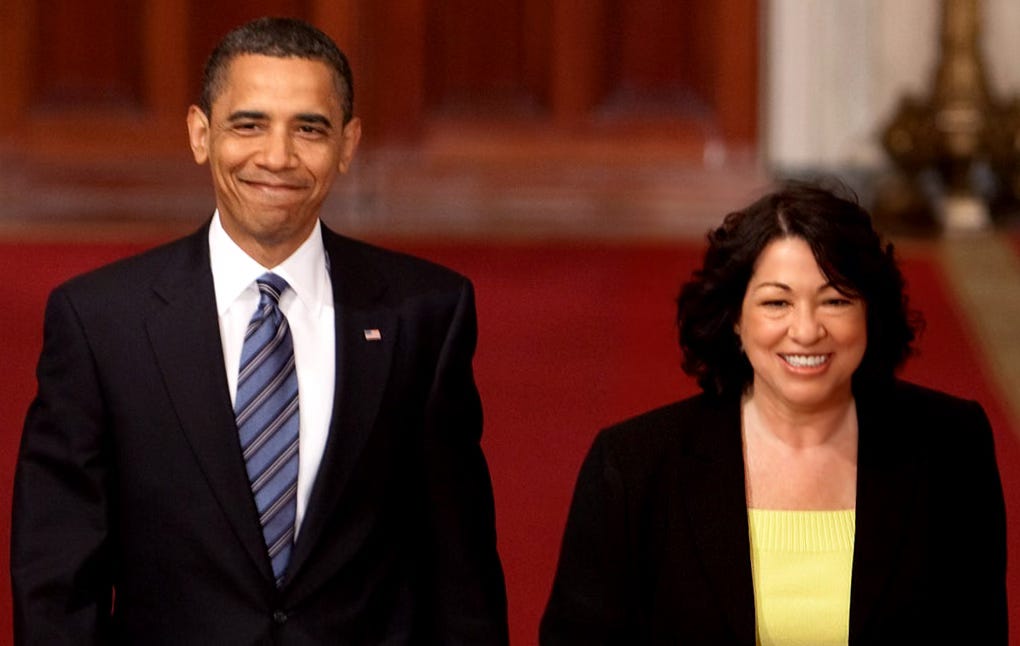
This Day in Legal History: Sonia Sotomayor Advances to the Supreme Court
On July 28, 2009, the Senate Judiciary Committee voted to approve the nomination of Sonia Sotomayor to the Supreme Court, sending her to the full Senate, which confirmed her the following week. With that confirmation she became the first Hispanic justice—and only the third woman—ever to serve on the Court.
Her path to the bench was the stuff of American mythology, and it was central to her nomination. Born in the Bronx to Puerto Rican parents, raised in a housing project, diagnosed with juvenile diabetes at seven and losing her father at nine, she went on to Princeton and Yale Law School, then worked as a Manhattan prosecutor before becoming a federal trial judge and later a judge on the Second Circuit Court of Appeals. As a district judge, she famously issued the injunction that ended the 1994–95 Major League Baseball strike. Her confirmation fight, though, turned heavily on a single phrase from an earlier speech—her remark that a “wise Latina” might, with the richness of her experiences, sometimes reach a better conclusion than someone without them. Critics called it bias; supporters called it an honest acknowledgment that lived experience shapes judgment.
In the years since, Sotomayor has become one of the Court’s most forceful liberal voices, known for pointed dissents on race, criminal justice, and—fittingly for today—the very “shadow docket” at the center of our lead story. She has been among the sharpest critics of the Court deciding major questions through emergency orders with little briefing and no argument. The significance of July 28, 2009 is both symbolic and substantive: symbolic, in that a woman from a Bronx housing project reached the pinnacle of the American legal system and expanded who Americans see reflected on their highest court; and substantive, in that she has spent her tenure insisting the Court explain itself and show its work—an insistence that lands with particular weight in a week when the justices are again being asked to make consequential law on the emergency docket.
The Trump administration has escalated its fight over mail-in voting all the way to the Supreme Court, asking the justices on an emergency basis to let its executive order take effect nationwide. This is the direct sequel to yesterday’s story: after the First Circuit refused on Saturday to lift the injunction blocking key parts of the March order, the Justice Department went straight to the high Court, asking it to put that injunction on hold while the litigation continues. The order directs federal agencies to build voter-eligibility lists and to restrict Postal Service delivery of ballots not tied to those lists; a coalition of 23 states and D.C. argues the President simply lacks authority to impose federal rules on elections that the Constitution assigns to states and to Congress. What’s notable here is the vehicle. This is an emergency application—part of what critics call the “shadow docket,” where the Court decides consequential questions quickly, often with little briefing and no full argument. Regular listeners will remember the shadow docket as a recurring concern precisely because it lets the Court make major law in the shadows. The justices have told the states to respond by August 3, so a decision could come fast. The significance is that one of the most consequential election-administration questions in years—decided against the administration twice below—is now in the hands of a Supreme Court being asked to act on an emergency timeline, months before the midterms.
Trump administration asks Supreme Court to allow mail-in ballot restrictions | Reuters
Johnson & Johnson has announced a $5.5 billion settlement to resolve tens of thousands of lawsuits claiming its talc products caused ovarian cancer—a deal that could finally close out more than a decade of litigation. The settlement would cover roughly 69,000 cases consolidated in New Jersey federal court plus related state cases, amounting to about 99.75% of the remaining talc claims. If you were with us last week, the timing is impossible to miss: just days ago, the federal magistrate judge overseeing those 69,000 cases cast serious doubt on whether the plaintiffs could even prove specific causation, ordering them to explain why their claims shouldn’t be dismissed. Days later, J&J puts $5.5 billion on the table. That sequence is a lesson in how litigation leverage works—a favorable evidentiary signal can push a defendant toward a global resolution on its own terms, or embolden it, depending on the read. The mechanics matter: the deal needs acceptance by 95% of the ovarian-cancer claimants and approval from the judge overseeing the federal litigation. And notably, J&J isn’t conceding anything—its litigation chief called the claims “meritless,” and the company still denies its talc caused cancer, though it pulled talc-based baby powder from U.S. and Canadian shelves back in 2020. The significance is that after years of trials, appeals, and two failed attempts to offload the liability through bankruptcy, J&J is choosing certainty and closure over continued combat—paying billions to make a decade of litigation risk go away, without ever admitting its product was dangerous.
Johnson & Johnson announces $5.5 billion settlement of talc lawsuits | Reuters
A major trial has opened in Nashville, where the state of Tennessee is telling a jury that Meta knew its Instagram platform was harming teenagers and buried the evidence to protect its profits. In opening statements for what’s expected to be a seven-week trial in state court, Tennessee’s lawyers said Meta’s own researchers repeatedly flagged that some teens were using the platform compulsively—linked to eating disorders, depression, and self-harm—yet the company declined to disable engagement features like autoplay, notifications, and infinite scroll, which the state says were designed to keep teens hooked and maximize the ads they saw. Meta’s lawyer countered that the company has been transparent about the risks teens face and about the dangerous content it works to find and remove. The legal theory here should sound familiar—it echoes the playbook used against Big Tobacco: the argument that a company’s own internal research proves it knew about the harm and chose profit anyway. That’s powerful evidence if the jury believes it, which is likely why, according to reporting, there’s already been a fight over whether Meta’s lawyers tried to keep some of that internal research out. This connects to threads we’ve followed all month, from the multistate suit seeking enormous penalties to the individual bellwether cases. The significance is that these harm-to-teens claims are now being tested in front of an actual jury, and the outcome will shape how Meta and its peers value the risk—and how aggressively other states and plaintiffs press similar cases.
Meta disregarded its own research on teen harm, Tennessee tells jury | Reuters
And finally, in my column for Bloomberg Tax this week, I use a striking data point—the Miami metro area’s cost of living has reportedly now surpassed greater New York City’s—to make a case about how we misunderstand what it means to call a state “low tax.” My core argument is that focusing on a single, highly visible tax like the income tax gives you a badly incomplete picture of whether a place is actually affordable, and for whom.
Here’s the logic. Florida markets itself relentlessly on having no personal income tax, and rankings like the Tax Foundation’s competitiveness index put Florida near the top and New York dead last largely on that basis. But I argue that conflates three very different claims: that Florida collects less through income taxes, that households there bear lower total costs, and that residents end up better off. Only the first is clearly true. The costs a state doesn’t cover through an income tax don’t vanish—they get shifted, recovered through other levies, or pushed into the private market. It’s the same principle as a restaurant that offers “free” parking: the cost of that parking is just baked into the price of the food. When Florida forgoes an income tax, residents still pay—through sales and property taxes, fees, sky-high insurance premiums, and services they have to buy privately that other states provide publicly. And because the income tax is the most progressive major revenue source a state has, replacing it with all of that tends to shift the burden down the income ladder.
The comparison I keep coming back to is the everyday cost that a public system absorbs in New York but a family pays out of pocket in Florida. New York guarantees every four-year-old a free, full-day pre-K seat; Florida’s program funds about 540 instructional hours—roughly three hours a day—leaving working parents to cover the rest. New York’s subsidized transit lets many households skip a car entirely. None of these private substitutes—an insurer, a toll road, a childcare provider—charges you less because you earn less, the way an income tax does. So here’s the distributional punchline of my piece: Florida’s model is a genuinely great deal if you make ten million dollars a year, because avoiding the income tax dwarfs everything else. But for the merely affluent professional making a few hundred thousand—and certainly for middle- and lower-income households—those insurance bills, tuition payments, and housing costs can quietly eat the whole “tax savings.” My bottom line is that any honest discussion of tax competitiveness has to start with comprehensive household-burden metrics across income levels, not a single headline rate—because “low tax” and “affordable” are not the same thing, and treating them as if they were lets officials sell breaks for the wealthy as broad affordability wins.
Miami’s Cost of Living Shows Income Tax’s Limits as a Metric | Bloomberg Tax


