


This Day in Legal History: The War on Poverty
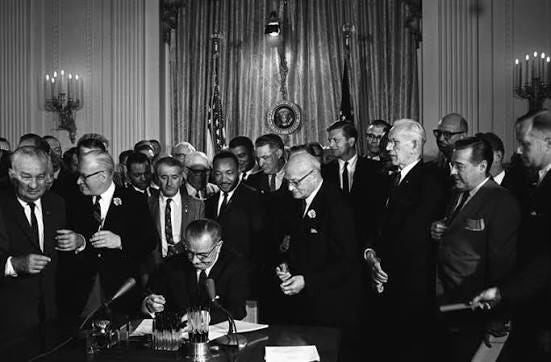
On August 20, 1964, President Lyndon B. Johnson signed the Economic Opportunity Act, the legislative centerpiece of the “War on Poverty” he had declared in his State of the Union address seven months earlier. It was among the most ambitious pieces of social legislation in American history. More fundamentally, it committed the federal government to the idea that poverty was not merely an individual misfortune, but a national problem the country could organize itself to confront.
The Act was broad by design. It authorized roughly $1 billion and created a collection of programs whose names remain familiar: the Job Corps, which trained young people; VISTA, conceived as a domestic version of the Peace Corps; the Neighborhood Youth Corps; and the Community Action Program. The last of those sent federal money directly to local organizations and required the “maximum feasible participation” of poor people in designing the programs intended to help them. The Act also created the Office of Economic Opportunity to oversee the broader effort. Head Start, which continues operating today, grew out of the same framework.
The legacy of August 20, 1964, is genuinely mixed, which is precisely why it is worth remembering honestly. The War on Poverty created durable institutions, including Head Start, Job Corps, and legal-services programs for poor Americans, while embedding the principle that the federal government has some responsibility for expanding opportunity. But the “maximum feasible participation” requirement also produced fierce battles between local activists and city governments that were accustomed to controlling federal money. The initiative was then starved of funding as the war in Vietnam consumed both the federal budget and the country’s political attention. The Economic Opportunity Act remains a reference point in nearly every argument about what the government owes its most vulnerable citizens. It also pairs pointedly with a day of legal news dominated by criminal prosecutions and judicial power—a reminder that law is not only a mechanism for punishment, but, at its most aspirational, a tool for creating opportunity.
In the trial of the man accused of orchestrating Tupac Shakur’s 1996 murder, the defense has settled on a genuinely remarkable strategy: asking the jury not to believe its own client. When we covered the opening of the trial, I noted that the case largely rests on Duane “Keffe D” Davis’s own words. Over the years, Davis said in media interviews and in a 2019 memoir that he was inside the Cadillac on the night Tupac was shot and that he handed the gun to the men in the back seat. Police had long suspected Davis, but they did not have enough evidence to charge him until he began publicly talking about the crime. His lawyer, Michael Sanft, is now attacking the reliability of those same admissions, at one point displaying a slide for jurors bearing a single word: “bullshit.” The defense theory is that Davis is a braggart who exaggerated or invented his involvement to sell books and improve his street reputation—and that self-aggrandizing talk is not proof beyond a reasonable doubt.
Legally, this is a fascinating position because Davis’s statements are doing much of the work a live confession ordinarily would, except that he made them for money and status rather than during a police interrogation. His effort to claim immunity based on a 2008 proffer has already failed before the Nevada Supreme Court, clearing the way for the statements to be used at trial. The case therefore turns on a basic but difficult evidentiary question: when someone publicly brags about participating in a notorious crime for personal gain, is that a confession the government can use to convict him, or is it just talk? The jury must decide whether Keffe D was telling the world the truth—or, as his own lawyer now argues, lying for profit.
Defense strategy in Tupac murder case: don’t believe my client | Reuters
CNN · KELO
President Trump has announced nine new judicial nominees for federal courts in Florida, Texas, Louisiana, Kentucky, Oklahoma, and Alaska as the November midterms approach. The group notably includes an Oklahoma state attorney who supported allowing taxpayer-funded religious charter schools, offering a preview of the church-state disputes these judges could eventually be asked to decide. The larger legal point is that lifetime federal judgeships may be the most durable form of power a president exercises.
These nominees, if confirmed, will continue interpreting federal law and the Constitution for decades after the president who selected them has left office. There is an unusual wrinkle this time, however: Trump’s pace of judicial appointments has slowed because there are not many vacancies left. His first term substantially reshaped the federal judiciary, and an aggressive beginning to his second term further reduced the number of available seats. That is why a nine-person slate spanning six states is meaningful in a year when there simply is not much left to fill. The “as midterms loom” framing matters as well, because control of the Senate determines whether a president’s nominees receive confirmation votes at all. The administration therefore has every reason to move nominees while the current Senate math remains favorable. Even a comparatively modest batch of nominations illustrates the quiet, cumulative way presidents shape American law—not through the executive orders that dominate a news cycle, but through lifetime appointments that survive countless news cycles. Each of these nine nominees, if confirmed, would represent a decades-long imprint on the federal judiciary.
Trump names nine new judicial nominees as November midterms loom | Reuters
Law360 · Bloomberg Law
And finally, we have a genuinely novel legal argument—literally. The Justice Department is prosecuting former FBI Director James Comey for allegedly threatening President Trump, and prosecutors are now pointing to Comey’s own novel as evidence against him. The charge arises from a May 2025 Instagram post in which Comey shared a photograph of seashells arranged on a beach to spell “86 47.” In that formulation, “86” is slang for getting rid of something, while “47” refers to Trump as the 47th president. Comey said he encountered the shells while walking on a North Carolina beach and posted the image as a clever piece of political commentary. Prosecutors have adopted a much darker interpretation. In a new filing urging the judge not to dismiss the case, the Justice Department cites Comey’s legal thriller FDR Drive, published that same month, in which a right-wing podcaster uses coded language to incite followers against political opponents.
The government’s theory is that the novel demonstrates Comey understood how coded language can function as a threat and therefore knew what “86 47” would communicate. Prosecutors also suggested that he exploited the resulting controversy to sell books, quoting a message to his agent in which Comey wrote that the attention was “not my intention, but I’ll be OK if it sells books.” The First Amendment does not protect “true threats,” but it strongly protects political criticism and hyperbole, and the Supreme Court has held that the government generally must prove a speaker was at least reckless about how a statement would be understood. The central question is therefore whether “86 47” amounted to a genuine threat of violence or protected political speech. Using a defendant’s fictional writing to establish his state of mind is an aggressive and unusual prosecutorial move. Comey’s lawyers describe the case as retaliation for his criticism of Trump. The prosecution sits directly on the fault line between criminalizing a threat and criminalizing dissent—and the government is effectively asking the court to treat a novelist’s imagination as evidence of criminal intent.
DOJ argues Comey novel shows he knew ‘86 47’ post was a threat against Trump | Reuters
CNBC · The Hill


