



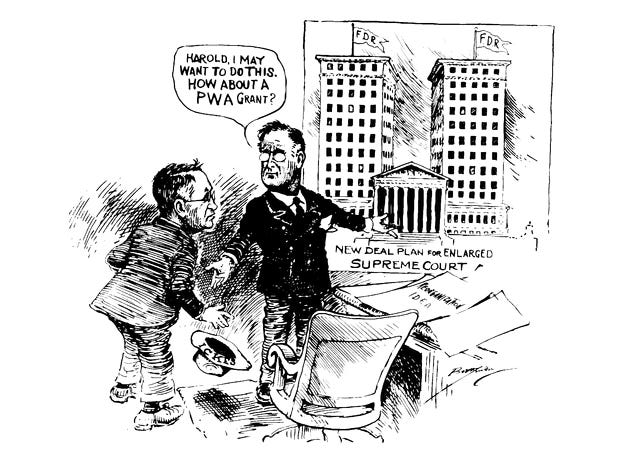
This Day in Legal History: The Senate Rejects Court-Packing
On July 22, 1937, the United States Senate rejected President Franklin D. Roosevelt’s plan to reorganize—critics said “pack”—the Supreme Court, voting 70 to 20 to send the bill to a quiet death. It was a stinging defeat for a president at the height of his popularity, delivered by his own party, and it settled a constitutional question that still shapes how we think about the independence of the judiciary.
The background was a collision between the New Deal and the Court. Through the mid-1930s, a conservative majority on the Supreme Court had struck down key pieces of Roosevelt’s economic program as unconstitutional. Frustrated after his landslide 1936 reelection, FDR proposed legislation that would have let him appoint a new justice for every sitting justice over the age of seventy—which, not coincidentally, would have allowed him to add up to six new justices and swamp the opposition. He framed it as a matter of efficiency and helping overworked elderly judges, but nobody was fooled; it was a naked attempt to change the Court’s decisions by changing its membership.
The plan backfired, and the reasons are the lesson. Even senators who supported the New Deal recoiled at the precedent—if this president could enlarge the Court to get the rulings he wanted, so could the next one, and the Court’s independence would become a fiction. Meanwhile, the Court itself defused the crisis: in the spring of 1937, Justice Owen Roberts began voting to uphold New Deal legislation, the famous “switch in time that saved nine,” which took some of the urgency out of FDR’s demand. The significance of July 22, 1937 is that it established a durable, if unwritten, constitutional norm—that the size of the Supreme Court is essentially off-limits as a tool for a president to overpower rulings he dislikes. The number nine isn’t in the Constitution, but the bipartisan rebuke of court-packing helped make it feel almost as if it were.
An analysis of the closely watched lawsuit by Meta employees over AI-driven layoffs highlights a hard truth: even when workers suspect an algorithm decided their fate, proving it is enormously difficult. To recap, 26 current and former Meta employees sued, alleging the company’s internal AI tools flagged them for termination because they have disabilities or took protected medical, parental, or family leave. Their theory is mechanically specific: because tools like the “Metamate” system scored employees partly on data such as keystroke activity, workers who were lawfully out on leave generated fewer data points and were disproportionately ranked as low-value. Meta cut roughly 8,000 people—about ten percent of its workforce—and says humans, not machines, made the decisions. Here’s why these cases are so hard to win. Anti-discrimination law generally requires the worker to show the employer’s decision was tainted by a protected characteristic, but the employee usually has almost no visibility into how the AI actually worked—the models, the training data, and the weighting are the company’s closely held secrets. On top of that, many employees have signed arbitration agreements, funneling their claims out of open court and into a private process that’s harder to see into and to appeal. The significance is that this appears to be the first case of its kind against a major U.S. company, and it exposes a growing gap: as employers hand more consequential decisions to opaque algorithms, the legal tools workers have to challenge those decisions—built for an era of human managers—may not be up to the job of proving what the machine did.
Analysis: Meta employees’ lawsuit shows that if AI fires you, proving it is the hard part | Reuters
A split panel of the D.C. Circuit has struck down a long-standing National Labor Relations Board doctrine that protected unions after a business changes hands, ruling that it conflicts with federal labor law. The doctrine at issue is the “successor bar,” and it works like this: when a company is acquired and a new employer takes over, that employer generally cannot challenge or withdraw recognition from the existing union for a reasonable period—about six months—giving the union and workers a window of stability to bargain with their new boss. The court held that this Board-created rule isn’t consistent with the National Labor Relations Act. What makes this ruling bigger than one labor doctrine is the tool the court used to get there. The decision applies the Supreme Court’s 2024 Loper Bright ruling, which overturned the decades-old Chevron doctrine and ended the requirement that courts defer to a federal agency’s reasonable interpretation of an ambiguous statute. Without that deference, the D.C. Circuit felt free to substitute its own reading of the labor law for the NLRB’s. This is exactly the dynamic I wrote about in my Bloomberg column last week in the tax context—the death of Chevron doesn’t erase statutory ambiguity, it just moves the power to resolve it from agencies to courts. The significance is that we’re now watching that shift play out across the administrative state: settled agency doctrines, some decades old, are suddenly vulnerable to being reinterpreted by judges, and here the immediate losers are unions and the workers who counted on a bargaining foothold after a merger.
US court says longstanding NLRB rule on post-merger union bargaining is invalid | Reuters
A federal judge has temporarily blocked the administration from stripping work authorization from tens of thousands of asylum seekers and immigrants with Temporary Protected Status. U.S. District Judge Nathaniel Gorton in Boston sided with a coalition of immigrant-rights groups and labor unions, halting U.S. Citizenship and Immigration Services from moving ahead with a set of policies while he weighs a longer-term pause; he said he’ll rule by August 5. Here’s the stakes and the legal frame. A work permit—formally, an employment authorization document—is what lets many immigrants lawfully hold a job while their asylum case or protected status is pending. Yanking it doesn’t just threaten deportation down the line; it immediately jeopardizes people’s livelihoods and their employers’ workforces. The contested policies were designed to implement immigration restrictions Congress enacted last year as part of the administration’s signature tax-and-spending law, the One Big Beautiful Bill Act. The plaintiffs argue USCIS is implementing those provisions in ways that exceed what the law allows and skip required procedures. A temporary block like this one preserves the status quo—keeping people employed—while the court decides whether the government followed the rules. The significance connects to a theme we keep returning to: courts serving as a check on how fast and how far the executive can move in reshaping immigration, insisting that even policies rooted in a real act of Congress still have to be implemented lawfully and with proper process.
US judge blocks Trump administration from stripping immigrants of work permits | Reuters
And finally, in my column for Bloomberg Tax this week, I dig into a self-inflicted mess in California: lawmakers scrambling to rework a business tax-credit cap that they apparently didn’t realize would kneecap Hollywood film studios. My core argument is that California is directionally right to resist subsidy bidding wars, but wrong to rewrite the economics of credits it has already issued after companies have started relying on them.
Here’s what happened. Since 2024, California has capped the total tax reduction a business can take from all its credits at $5 million a year. That cap was set to expire after 2026—right as productions were going to start claiming credits under a newly expanded film incentive the state had just touted as a centerpiece of keeping film jobs in California. Instead, a bill called SB 122 extended the $5 million limit through 2029 and then converts it to the greater of $5 million or 70% of taxes owed. The part that really gets me is the admission underneath it: lawmakers passed a $351.7 billion budget without apparently understanding how this cap would interact with the film credit they’d just enlarged. As one assemblymember candidly put it, “I’m not sure who knew what about what.” It looks like the cap was really aimed at large research-and-development credit stockpiles, and film credits just got caught in the crossfire.
My argument is that the distinction between prospective and retroactive matters enormously here. It’s one thing for California to decide, going forward, that future subsidies will be smaller or conditioned—that’s legitimate fiscal discipline, and I don’t think Hollywood should get to dictate tax policy just by threatening to decamp to Georgia. But it’s another thing entirely to change the timing and practical value of credits after studios have already committed workers, facilities, and financing in reliance on the old rules. When a state does that, it makes itself a less credible counterparty, and it quietly reduces the value of every future incentive it offers, because businesses will start discounting California’s promises for legislative risk. So my prescription is targeted: protect the film credits already awarded under the prior rules, keep a real limit on the big accumulated R&D credits that were the actual target, and replace the blunt across-the-board cap with rules tailored to how these very different credits actually work. California doesn’t have to choose between fiscal discipline and keeping its word—its tax policy can be skeptical, but its promises should still mean something.
California’s Business Tax Credit Cap Needs More Targeted Changes | Bloomberg Tax


