


This Day in Legal History: The Declaration of Sentiments
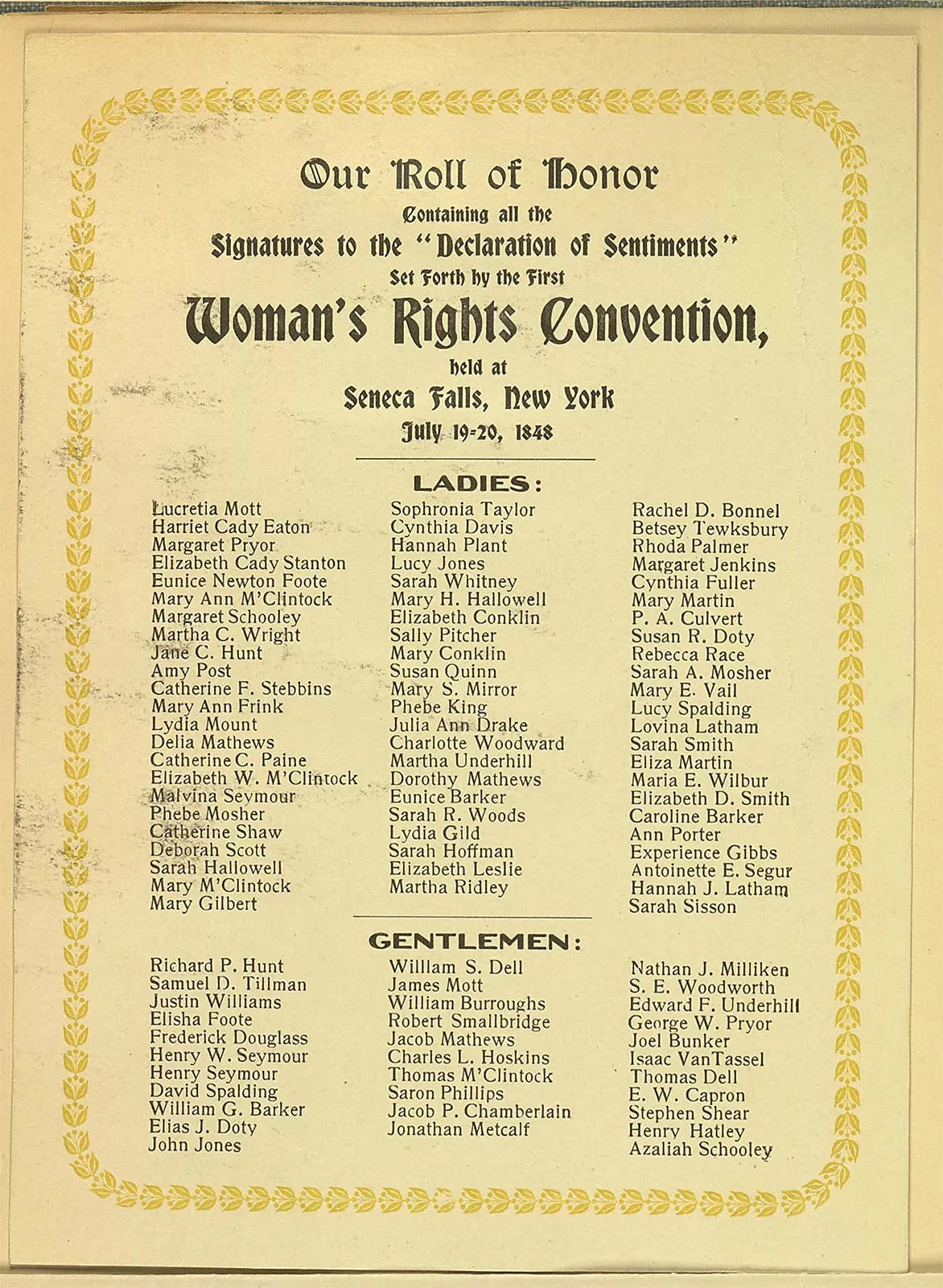
On July 20, 1848, at the close of the two-day Seneca Falls Convention in upstate New York, roughly a hundred people signed the Declaration of Sentiments—the founding document of the organized women’s rights movement in the United States. Drafted principally by Elizabeth Cady Stanton, it was a deliberate and pointed act of legal argument: Stanton modeled it on the Declaration of Independence, echoing Jefferson’s cadences but adding two words that changed everything—”that all men and women are created equal.”
The genius of the document was to take the nation’s own founding logic and turn it on the exclusion of half the population. It then catalogued, in the form of a bill of particulars against “man” rather than King George, the specific legal disabilities women lived under. Married women had no right to their own property or wages—under the common-law doctrine of coverture, a wife’s legal identity was absorbed into her husband’s. Women could not vote, were barred from most professions and higher education, had almost no rights to their own children in the event of separation, and were governed by laws they had no voice in making. The Declaration listed these as concrete legal grievances, not vague complaints, framing the denial of women’s rights as a violation of the country’s stated principles.
The most controversial demand was the resolution calling for women’s suffrage, which passed only narrowly and with the public support of Frederick Douglass, who attended the convention. The significance of July 20, 1848 is that it launched a legal and political campaign that would take seventy-two years to win the vote, with the Nineteenth Amendment in 1920, and far longer to dismantle coverture and the web of laws built on women’s legal subordination. It’s a reminder that constitutional principles are not self-executing—that “all men are created equal” had to be argued, expanded, and fought for by the people the original text left out.
A federal appeals court has struck down New Jersey’s ban on assault firearms and high-capacity magazines, the first time any federal appeals court has invalidated a state assault-weapons ban. Sitting en banc, the Philadelphia-based Third Circuit ruled 10-5 that the state’s prohibition on semi-automatic rifles—not just AR-15s, but the whole category—violates the Second Amendment, as does its ban on magazines holding more than ten rounds. The reasoning flows from the Supreme Court’s recent framework, which asks whether a gun regulation is consistent with the nation’s historical tradition of firearms regulation; the majority concluded these bans are not. What makes this a genuinely big deal is the split it creates. Just last week, a different federal appeals court upheld Illinois’s ban on semi-automatic weapons—so we now have appeals courts squarely disagreeing on whether these bans are constitutional. That kind of circuit split is precisely the condition that draws the Supreme Court in, and the Court is already poised to take up whether bans on semi-automatic rifles violate the Second Amendment. The significance is that a question affecting roughly a dozen states with similar laws is now barreling toward a definitive answer. For the moment, New Jersey’s ban is unenforceable as to these weapons, but the durability of that outcome—and of assault-weapons bans nationwide—now depends on what the Supreme Court does next.
US appeals court declares New Jersey’s ban on assault rifles unconstitutional | Reuters
A federal judge has ruled that the Trump administration cannot rely on a White House budget-office regulation to cancel billions of dollars in grants simply because those grants no longer match its priorities. U.S. District Judge Indira Talwani in Boston sided with a coalition of Democratic-led states, rejecting the administration’s claim that a clause in Office of Management and Budget regulations gave it authority to revoke funding whenever an agency’s focus shifts. Here’s the underlying principle. When Congress appropriates money for a program and an agency awards grants under it, the government generally can’t just take that money back on a whim—grant recipients have relied on it, and the terms for termination are limited. The administration’s theory was that an OMB regulation let it terminate grants it deemed “inconsistent with agency priorities,” effectively a roving power to defund causes it disfavors. Judge Talwani found the regulation didn’t authorize anything of the kind. The significance connects to a theme we keep returning to: the limits of executive power over money that Congress has already directed. The administration has repeatedly tried to redirect or withhold funds to reshape policy without going through Congress, and courts have repeatedly pushed back. This ruling reinforces that a president’s control over federal spending, though real, is bounded—an agency can’t retroactively pull grants just because political priorities changed.
Trump administration cannot cancel grants for disfavored causes, US judge rules | Reuters
A federal judge has declined to block Meta from laying off 26 employees who claim the company’s AI tools singled them out for termination because they have disabilities or took medical leave. U.S. District Judge William Orrick in Oakland ruled that the workers hadn’t shown the “irreparable harm” needed for an emergency order halting the layoffs, which are set to begin July 22, and that the merits of their novel claims will be decided in private arbitration. The allegations are striking. The plaintiffs—engineers, managers, researchers, and designers suing anonymously—say Meta used a suite of internal AI systems to score and rank employees onto a termination list, including an assistant called “Metamate,” an employee-trained “second brain” that tracked workers’ communications, and a productivity score drawn from scanning keystrokes, screen content, emails, and browser history. Meta denies wrongdoing and insists humans, not algorithms, made the layoff decisions. This is a frontier legal question: when an employer uses AI to help decide who gets cut, and those tools allegedly disadvantage people with disabilities or on leave, is that illegal discrimination? The judge’s refusal to block the layoffs was procedural—losing a job usually isn’t “irreparable” because money damages can fix it—but he pointedly noted the case raises “serious questions” and said he might reconsider based on more evidence about how AI was actually used. The significance is that algorithmic management is colliding with anti-discrimination law, and courts are just beginning to work out who’s accountable when the machine does the ranking.
US judge won’t block Meta from laying off workers who filed AI discrimination lawsuit | Reuters
And finally, the IRS’s top lawyer has been forced out after refusing White House demands that would have drawn him into tax audits of particular taxpayers. Ken Kies, who served as the agency’s acting chief counsel and as Treasury’s assistant secretary for tax policy, told administration officials their requests would violate a federal law that bars the president, the vice president, and other White House officials from ordering the IRS to conduct or terminate an audit of any specific taxpayer. That statute is a direct legacy of Watergate-era abuses, when presidents tried to sic the tax agency on their enemies, and tax professionals regard it as the single most important safeguard against weaponizing the tax code. Kies apparently stood on that law—and lost his job for it. The story connects directly to one we covered recently: the administration’s $1.8 billion “anti-weaponization” settlement that would have given the president and his family immunity from IRS audits, which a federal judge struck down as a collusive arrangement with no basis in law. The significance is about the fragile independence of tax administration. The protections that keep audits free from political direction only work if the officials inside the agency are willing to enforce them—and when the person who says “no” to an unlawful demand is pushed out, it sends a chilling message to everyone who remains.
Top US tax lawyer forced out after White House clash over tax audits | Reuters


