


This Day in Legal History: Congress Shrinks the Supreme Court
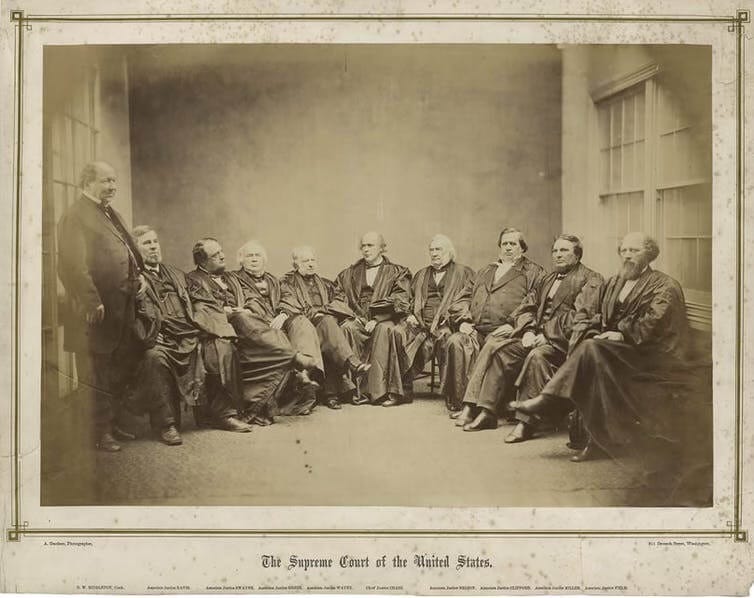
On July 23, 1866, Congress passed the Judicial Circuits Act, and in doing so did something that sounds almost unimaginable today: it shrank the Supreme Court. The Act provided that the Court would gradually contract from ten justices down to seven, as sitting justices died or retired and their seats simply went unfilled. Yesterday we talked about Franklin Roosevelt’s failed attempt to enlarge the Court to overpower it; today’s anniversary is the mirror image—Congress reducing the Court’s size for pointedly political reasons.
The politics were about President Andrew Johnson. Johnson, who had ascended to the presidency after Lincoln’s assassination, was locked in a bitter struggle with the Radical Republicans in Congress over Reconstruction. Congress did not trust him, and one thing it was determined to deny him was the power to shape the Supreme Court. By legislating that upcoming vacancies would go unfilled until the Court shrank to seven, Congress effectively stripped Johnson of any Supreme Court appointments. It was court-unpacking as a weapon of inter-branch warfare—using Congress’s control over the Court’s size not to change its rulings directly, but to lock a distrusted president out of influencing it.
The size of the Supreme Court has never been fixed by the Constitution—it’s set by statute, and it has ranged from six at the founding up to ten and back down over the country’s first century. After Johnson left office, Congress promptly passed the Judiciary Act of 1869 and settled the number at nine, where it has remained ever since. The significance of July 23, 1866 is that it’s the clearest historical example of Congress manipulating the Court’s very size for immediate political advantage—and, paired with the 1937 court-packing fight, it bookends the story of how the number nine came to feel sacrosanct even though it never actually was. The Court’s independence, it turns out, has always rested partly on a political truce about not touching its structure.
A Manhattan federal judge is set to weigh today whether to throw out the Justice Department’s subpoenas to New York Times journalists who reported on security concerns about President Trump flying on a Qatari-donated Air Force One. This is the next chapter of a story we covered when the subpoenas first landed: they were issued July 10 by the Manhattan U.S. Attorney, and U.S. District Judge Arun Subramanian has paused their enforcement pending this afternoon’s hearing. The two sides want very different things. Prosecutors have asked the judge merely to put the subpoenas on hold for a couple of weeks, saying the investigation’s next steps could shape his decision; the Times wants them quashed outright, arguing they’re designed to harass and intimidate journalists in violation of the First Amendment. The legal backdrop is genuinely unsettled. There is no absolute reporter’s privilege under federal law—prosecutors correctly note the First Amendment doesn’t categorically excuse reporters from testifying in criminal investigations—but courts have long been wary of subpoenas that function as fishing expeditions to unmask sources. The significance is that this hearing is a concrete test of where that line falls, and it lands amid a broader pattern we’ve tracked all month of friction between the administration and the press. However Judge Subramanian rules, it will be an early data point on how much protection newsgathering gets when the government wants to know who talked.
US judge to weigh New York Times subpoenas over Trump plane reporting | Reuters
The teenager at the center of a closely watched lawsuit blaming social media for his depression and anxiety has dropped his claims against Meta just days before trial. The plaintiff, a 15-year-old known in court papers as R.K.C., had originally sued four companies—Google’s YouTube, Meta’s Instagram, Snap’s Snapchat, and ByteDance’s TikTok—alleging their platforms were engineered to be addictive and harmed his mental health. YouTube, TikTok, and Snap all reached confidential settlements earlier, which would have left Meta as the lone defendant when the case went before a Los Angeles jury on July 27. Instead, R.K.C. withdrew, ending the case. Here’s why this matters beyond one teenager. His was a “bellwether” case—one of a small set of representative lawsuits chosen from a huge pool of similar claims and tried first, so both sides can see how juries react and use those signals to gauge settlement values across the whole litigation. When a marquee bellwether evaporates right before trial, it sends a message, though an ambiguous one: it could reflect a quiet settlement, a weakness in this particular plaintiff’s proof, or simply strategic repositioning. The significance is that the sprawling social-media-harm litigation against these platforms rolls on, but this particular test balloon won’t be inflated—depriving both the companies and the thousands of other plaintiffs of a data point they were watching closely.
A federal judge has cast serious doubt on roughly 69,000 lawsuits claiming that Johnson & Johnson’s talc products caused ovarian cancer, warning the plaintiffs they must come forward with better evidence or risk having their cases dismissed. U.S. Magistrate Judge Rukhsanah Singh in Trenton, New Jersey, zeroed in on a problem at the heart of the litigation: causation. In a mass tort like this, plaintiffs generally have to show not just that a product can cause harm in the abstract—”general causation”—but that it caused this particular plaintiff’s disease—”specific causation.” Judge Singh noted that two of the plaintiffs’ own expert witnesses, testifying in preparation for a set of bellwether trials, conceded they could not rule out other possible causes of the women’s cancers. That’s a serious admission, because it goes to whether the experts can offer an opinion that’s admissible at all under the rules that make judges the “gatekeepers” of scientific testimony. If you’ve been listening, this should ring a bell—it’s the same expert-gatekeeping battleground we saw in the Tylenol-autism case, just cutting the other direction. Here the judge ordered plaintiffs to explain, by November 19, why their cases shouldn’t be tossed for lack of an admissible expert opinion tying J&J’s talc to their specific cancers. The significance is that after years of litigation, settlements, and failed bankruptcy maneuvers, the whole edifice of these 69,000 claims may hinge on a question of scientific proof—and the judge just signaled the plaintiffs have a real problem.
US judge casts doubt on 69,000 cases alleging J&J talc caused cancer | Reuters
And finally, in a piece I wrote for Forbes this week, I make an argument that runs underneath a lot of the tax stories we’ve covered lately: the tax code is only as real as its enforcement. My core claim is that defunding the IRS doesn’t actually shrink the tax code—it quietly splits it into two.
Here’s the framing I start with. Washington has a strange way of talking about tax enforcement. Money to help the IRS collect taxes that are already legally owed gets described as spending, waste, or bureaucratic excess—but when Congress cuts that funding and less revenue comes in, the shortfall gets treated like weather, as if it just happened. I think that’s exactly backwards. Congress can write whatever rates, deductions, partnership rules, and anti-abuse provisions it likes, but without skilled auditors and functioning technology, a big chunk of those rules becomes purely aspirational.
And crucially, that aspiration isn’t evenly distributed. For most wage earners, there’s almost no room to maneuver: your income is reported by your employer, your taxes are withheld before you ever see the paycheck, and a computer can flag a mismatch without a human ever looking at your return. But wealthier filers and large businesses often operate through partnerships, closely held entities, cross-border transactions, and complex securities arrangements that take specialized expertise and real time to unwind. So my point is that defunding the IRS doesn’t create a smaller tax code—it creates two codes: a statutory, basically inescapable one for people whose income is visible, and a negotiated one for people whose finances are complicated enough to delay, obscure, or contest what they owe. Strip out the enforcement capacity, and the nominal rule stays on the books while its practical effect on the highest earners quietly weakens. That’s regressive—a backdoor tax cut for the taxpayers best positioned to resist enforcement.
There’s a new bill, the Stop CHEATERS Act, that would restore enforcement funding, and I think its sponsors are right about the underlying problem. But I argue they should retire the “fair share” language they’ve wrapped around it. “Fair share” is subjective—reasonable people can argue forever about whether capital gains should get preferential treatment or whether the top rate is too high or too low, and those are legitimate legislative questions. But that’s not the issue here. Congress already wrote the laws; taxpayers are already obligated to follow them. The case for funding the IRS isn’t about inventing a new standard of fairness after the fact—it’s about consistently administering the standards we already have. By leaning on “fair share,” Democrats risk making basic enforcement sound like a partisan redistribution project when the stronger, harder-to-dismiss argument is simply this: if Congress imposes a tax, the government should be funded well enough to collect it. Anything less isn’t restraint or a considered policy choice—it’s a quiet exemption for those who can afford to fight.


