


This Day in Legal History: The Dodd-Frank Act
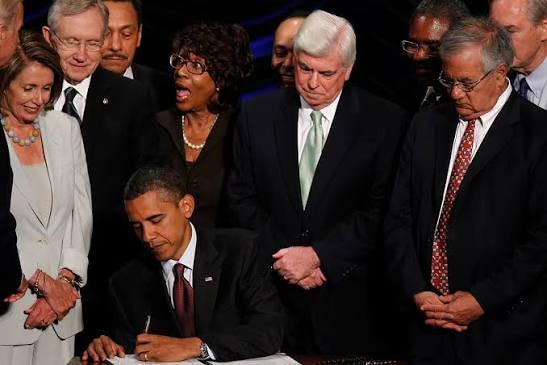
On July 21, 2010, President Barack Obama signed the Dodd-Frank Wall Street Reform and Consumer Protection Act, the most sweeping overhaul of American financial regulation since the New Deal. It was a direct response to the 2008 financial crisis—the collapse that wiped out trillions in household wealth, toppled storied institutions like Lehman Brothers, and required massive taxpayer bailouts to keep the banking system from failing entirely.
Dodd-Frank tried to attack the crisis’s root causes on several fronts at once. It created the Financial Stability Oversight Council to watch for systemic risks—the danger that one firm’s failure could cascade through the whole economy—and gave regulators new “resolution authority” to wind down failing giants in an orderly way, an attempt to end the problem of banks being “too big to fail.” It imposed the Volcker Rule, restricting banks from making certain speculative bets with depositors’ money. It brought the shadowy derivatives market under federal oversight. And, in its most visible legacy, it created the Consumer Financial Protection Bureau—a new agency dedicated to policing mortgages, credit cards, and other consumer financial products, born largely from an idea championed by then-professor Elizabeth Warren.
Dodd-Frank has been contested ever since—fought over in rulemaking, trimmed by later legislation, and litigated all the way to the Supreme Court, including a major case over the constitutionality of the CFPB’s structure. But its core significance endures: it represents the country’s considered legal judgment that concentrated financial power, left unchecked, poses a systemic danger, and that the answer is robust administrative regulation. It’s a fitting anniversary to sit alongside today’s news, because so much of what we cover comes back to the same enduring question—how the law should restrain private economic power without strangling the enterprise that power creates.
A federal judge has temporarily paused Paramount Skydance’s roughly $110 billion acquisition of Warner Bros. Discovery, siding for now with a coalition of twelve state attorneys general who sued to stop it. U.S. District Judge Araceli Martínez-Olguín issued a fourteen-day temporary restraining order, finding the deal “likely” violates antitrust law. Here’s the framework. Antitrust law exists to preserve competition, and one of its central tools is blocking mergers that would concentrate too much market power in a single company. The states, led by California, sued on July 13 arguing that combining these two entertainment giants would create a media behemoth with the power to raise prices across film and television and to squeeze rivals. A temporary restraining order is exactly what it sounds like—a short-term freeze to preserve the status quo while the court takes a harder look; the “likely violates” language signals the states cleared the initial bar of showing they’re reasonably likely to succeed. It is not a final ruling that the merger is illegal. The significance is twofold. First, it’s a reminder that even after companies strike a deal, they still have to clear the antitrust gauntlet, and state attorneys general—not just federal enforcers—can be the ones holding the gate. Second, the sheer scale here, a hundred-and-ten-billion-dollar combination of major studios and networks, makes this a marquee test of how aggressively courts will scrutinize consolidation in an industry that shapes what Americans watch.
Judge orders Paramount to temporarily pause Warner Bros. acquisition | Reuters
A federal judge has granted final approval of Anthropic’s $1.5 billion settlement with a class of authors who accused the AI company of misusing their books to train its chatbot Claude—the largest known copyright settlement in U.S. history. The deal works out to roughly $3,000 per work across an estimated 500,000 books, split among the authors and publishers who hold the rights. The legal backstory is important, because it’s more precise than “AI company pays authors.” The now-retired Judge William Alsup, who first handled the case, drew a careful line: he suggested that training AI on lawfully acquired books could qualify as fair use, but found that Anthropic had violated authors’ rights by downloading and storing more than seven million pirated books in a “central library”—copies it obtained illegitimately, regardless of whether they were ultimately used for training. In other words, the core wrong the settlement addresses is the piracy—the acquisition and hoarding of stolen copyrighted works—not simply the act of training itself. The settlement drew objections from some authors who argue it’s too small, overpays the plaintiffs’ attorneys, or wrongly leaves out certain rights holders, and the judge had to weigh those before signing off. The significance is that this sets a real-world price on one flavor of AI’s copyright problem. It doesn’t resolve the biggest open question—whether training on copyrighted material is itself lawful—but it establishes that how you got the training data matters enormously, and that building your library out of pirated books can cost you well over a billion dollars.
US judge approves Anthropic’s $1.5 billion settlement of copyright lawsuit | Reuters
And finally, the Justice Department has announced a civil-rights probe into Harvard University, this time over its financial aid programs. The Department’s Civil Rights Division says it has opened a “compliance review” to determine whether Harvard’s China-based financial aid arrangements discriminate on the basis of national origin by steering aid to foreign—presumably Chinese—students in a way that excludes American citizens. The theory rests on an unusual inversion of civil-rights law. Statutes like Title VI of the Civil Rights Act bar recipients of federal funding from discriminating based on national origin, and they’ve historically been used to protect racial and ethnic minorities. Here the DOJ is deploying that framework to allege discrimination against American-citizen students. The trigger, according to the Department, was an audit of Harvard’s foreign-funding disclosures showing the university has received more than $630 million from sources based in China, some of it allegedly earmarked, through donor restrictions, for aid to particular students. Harvard says it’s reviewing the letter and will engage with the government. The significance is that this is the latest salvo in a sustained campaign against Harvard and other elite universities, which have faced probes and funding threats over everything from admissions to campus protests. Whatever the merits of this specific allegation, the pattern is what’s notable: the machinery of federal civil-rights enforcement being aimed, repeatedly and pointedly, at a handful of institutions the administration has publicly targeted.
US DOJ says it is probing Harvard over financial aid programs | Reuters


