



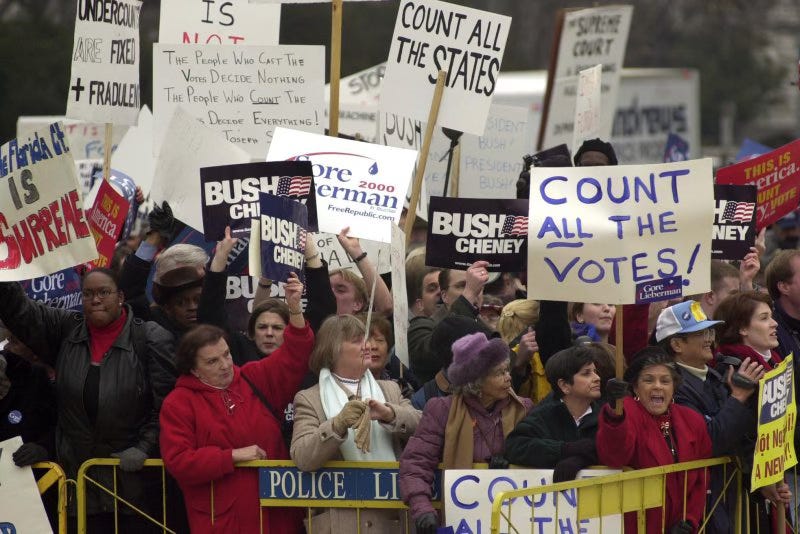
This Day in Legal History: Bush v. Gore
On December 12, 2000, the U.S. Supreme Court issued its landmark decision in Bush v. Gore, effectively ending the Florida recount and resolving the 2000 presidential election in favor of George W. Bush. The per curiam opinion held that the Florida Supreme Court’s method for ordering a manual recount violated the Equal Protection Clause of the Fourteenth Amendment due to inconsistent standards across counties. The Court also ruled that there was not enough time to implement a constitutionally valid recount before the deadline for certifying electors.
The decision was one of the most controversial in the Court’s history. It was split 5-4 along ideological lines, with the majority—led by Chief Justice Rehnquist and Justices Scalia, Thomas, Kennedy, and O’Connor—arguing that allowing the recount to continue would irreparably harm Bush. The dissent, written by Justices Stevens, Ginsburg, Breyer, and Souter, criticized the majority for intervening in a state election process and undermining public confidence in judicial neutrality.
The ruling effectively awarded Florida’s 25 electoral votes to Bush, giving him 271 electoral votes—one more than needed to win the presidency—despite losing the national popular vote to Al Gore. The case remains a flashpoint in debates over judicial activism, the politicization of the courts, and the role of federal courts in state election matters. It also raised enduring questions about election integrity and the limits of judicial power in resolving political disputes.
The watchdog group American Oversight filed a lawsuit against the U.S. Commerce and Justice Departments, demanding records of legal arrangements between the Trump administration and nine major law firms. The group had submitted eight Freedom of Information Act (FOIA) requests in October seeking details about agreements in which the firms pledged to provide nearly $940 million in pro bono or discounted legal services to the federal government. After receiving inadequate responses, the group took legal action to compel the release of any related contracts, communications, or internal legal analyses.
The agreements were announced by Trump earlier in the year on social media, shortly after he issued executive orders targeting law firms for their previous political and diversity-related work. American Oversight is particularly concerned about whether the deals were transparent and whether they might have influenced government policy or enforcement decisions. Several firms—Kirkland & Ellis, Paul Weiss, Simpson Thacher, and Skadden Arps—were reported to have been involved in trade matters or other projects with the administration. None of the firms or the agencies responded to requests for comment.
This lawsuit follows a similar legal action by Columbia University’s Knight First Amendment Institute, which alleged in October that related federal record requests had been improperly denied. Meanwhile, Democratic lawmakers have also asked several of the firms to explain their government work, but the firms declined, citing client confidentiality and discretion in matter selection.
Trump administration sued for records of law firm deals | Reuters
A federal judge blocked a renewed attempt by immigration authorities to detain Kilmar Abrego, just one day after his court-ordered release from ICE custody in Pennsylvania. U.S. District Judge Paula Xinis had previously ordered Abrego’s temporary release, but an immigration judge quickly issued a new directive requiring him to report back to detention by the following morning. In response, Abrego’s attorneys filed an emergency request to stop the re-detention, which Xinis granted.
In her ruling, Judge Xinis emphasized that judicial decisions must be respected and cannot be reversed hastily without due process. Abrego’s case has drawn national attention, serving as a high-profile example of what critics view as the Trump administration’s heavy-handed immigration enforcement tactics. Originally deported in March to El Salvador under disputed circumstances, Abrego was returned to the U.S. in June to face charges related to human smuggling.
Supporters argue his case reflects serious due process violations, while administration officials have maintained he poses a public safety risk. The legal tug-of-war over Abrego’s detention has become emblematic of broader legal and political conflicts surrounding immigration enforcement and civil liberties under the Trump administration.
Judge blocks new effort to detain Kilmar Abrego | Reuters
A federal judge in Boston ruled that the Trump administration acted unlawfully when it attempted to terminate a FEMA program designed to help states prepare for natural disasters. U.S. District Judge Richard Stearns sided with a coalition of 20 mostly Democratic-led states, finding that the administration overstepped its authority by trying to cancel the Building Resilient Infrastructure and Communities (BRIC) program and redirect its funds elsewhere without congressional approval.
The Department of Homeland Security, which oversees FEMA, had labeled the program wasteful and politically driven when it moved to end it in April. Judge Stearns rejected that rationale, emphasizing that Congress—not the executive branch—has the power to decide how federal funds are spent. He previously issued an order in August blocking FEMA from diverting more than $4 billion in BRIC funding. In this latest decision, he ordered the program reinstated and required FEMA to take immediate steps to undo its termination.
Massachusetts Attorney General Andrea Joy Campbell praised the ruling, stating it would save lives by preserving funding for critical infrastructure improvements meant to prevent disaster-related harm. The Department of Homeland Security, in contrast, denied that it had ended BRIC and accused the court of siding with a politicized narrative, claiming the program had been misused by the Biden administration.
Since its launch, BRIC has approved over $4.5 billion in grants for nearly 2,000 disaster mitigation projects, many located in vulnerable coastal states. The lawsuit, led by states like Washington and Massachusetts, argued that canceling the program delayed or canceled hundreds of vital community projects aimed at reducing disaster risk.
Trump administration unlawfully canceled disaster prevention program, US judge rules | Reuters
President Trump announced an executive order threatening to withhold federal broadband funding from states with AI regulations deemed obstructive to national technological dominance. The order targets state-level laws that the administration argues create a fragmented, burdensome environment for AI innovation, particularly for startups. Trump emphasized the need for a single, centralized regulatory system, positioning the U.S. to compete more aggressively with China in the AI sector.
The order authorizes the Commerce Department to review state AI laws and restrict access to the $42 billion Broadband Equity Access and Deployment fund for non-compliant states. It also criticizes anti-discrimination measures in states like Colorado, claiming such laws inject “ideological bias” into AI development. While the administration supports certain safeguards, such as child protection, it aims to dismantle what it sees as excessive oversight.
Critics argue the move undermines state authority and risks public safety. Representative Don Beyer warned the order violates the 10th Amendment and discourages meaningful congressional action. State leaders from both parties have defended their right to regulate AI, citing the federal government’s inaction on tech legislation. States like New York, California, and Florida have already enacted laws addressing AI’s risks, from data transparency to deepfake bans.
Trump threatens funding for states over AI regulations | Reuters

This week’s closing theme is by Abigail Leahey and her classmates.
This week, we are proud to present a performance of singular clarity, youthful ambition, and the product of more than a little bit of dedicated practice: The First Scale March, recorded live on December 10th at a school Winter Concert. Its thematic simplicity belies its pedagogical complexity: it is equal parts warm-up and war cry. The holidays are upon us.
The featured artist, Abigail, is one of several violins. She was born in New Jersey in 2014 and has been defying expectations and delighting her family ever since. A gifted writer, illustrator, softball player, and—crucially—violinist, she began studying the instrument in earnest in early 2025. In a bold display of ambidextrous courage, she agreed to learn the instrument right-handed.
Abigail’s musical sensibility combines the raw urgency of a student recital with the unmistakable rhythmic intensity of a group trying very hard to play the same tempo at the same time. Her phrasing evokes a deep respect for the discipline of practice; she has come a long way—and is still going.
We are honored to showcase this piece as a representative work from a performer at the dawn of her musical journey, backed by a supporting cast of equally determined string players. With hearts full and bows raised, they march forward—one note at a time.


