


This Day in Legal History: The National Minimum Drinking Age Act
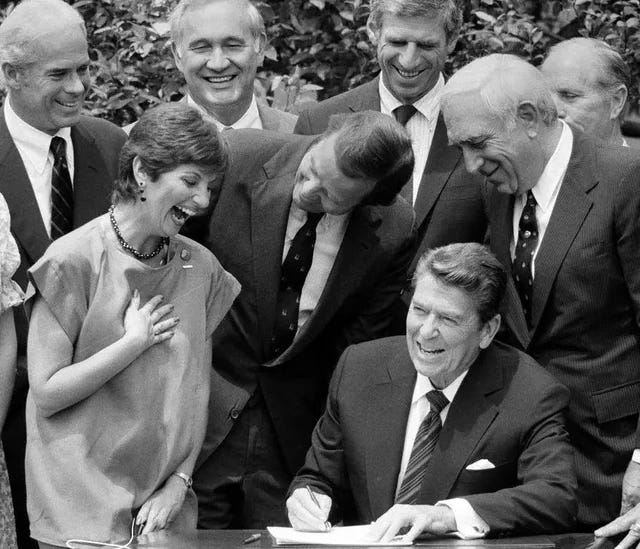
On July 17, 1984, President Ronald Reagan signed the National Minimum Drinking Age Act, the law that effectively set the drinking age at 21 across the entire country. What makes the Act a fixture of law-school classrooms isn’t the policy itself—it’s the clever, and constitutionally fraught, mechanism Congress used to achieve it.
Here’s the problem Congress faced. Setting a drinking age is a classic exercise of state police power; the federal government has no general authority to tell states how old someone must be to buy a beer. So Congress didn’t order the states to do anything. Instead, it reached for its spending power. The Act directed that any state which failed to raise its drinking age to 21 would lose a percentage of its federal highway funds. States remained technically “free” to keep a lower drinking age—they’d just forfeit a slice of the highway money they depended on. Within a few years, every state had fallen into line.
South Dakota challenged the law, and in the 1987 case South Dakota v. Dole, the Supreme Court upheld it. The Court laid out the framework that still governs conditional federal spending: conditions must be unambiguous, related to a federal interest, not otherwise unconstitutional, and—critically—must not be so coercive that they amount to “compulsion” rather than mere “encouragement.” The Court decided that losing about five percent of highway funds was just mild pressure, not coercion. That last piece became enormously important decades later. In the 2012 healthcare decision, NFIB v. Sebelius, the Court for the first time found that a spending condition had crossed the line into unconstitutional coercion, when Congress threatened states with the loss of all their Medicaid funding. The significance of July 17, 1984 is that a law about drinking age quietly established the constitutional playbook for how the federal government leverages its money to steer state policy—and where the limits of that leverage finally lie.
A federal appeals court has reinstated the Pentagon’s policy requiring journalists to be accompanied by a government escort inside the building, handing the Trump administration a win in its press-access fight with The New York Times. A lower-court judge had blocked the escort requirement in June, but a three-judge panel of the D.C. Circuit put it back in place. The legal reasoning is worth parsing. The Times argued the escort rule was retaliation against the press in violation of the First Amendment. The panel disagreed—at least for now—finding the Pentagon likely to succeed on its argument that a “generally applicable escort requirement” isn’t a “sufficiently adverse action” to support a First Amendment retaliation claim. In other words, because the rule applies to all reporters rather than singling out particular outlets or viewpoints, the court was skeptical it amounts to unconstitutional retaliation. This is an interim ruling on a preliminary question, not a final decision; the Times says it looks forward to litigating the merits on an expedited basis. The significance is part of a broader pattern we’ve tracked this week—friction between the administration and the press over access and newsgathering. Here the court signaled that neutral, across-the-board restrictions on where reporters can roam are harder to attack than targeted ones, even as the deeper question of press access to the government remains very much alive.
US appeals court keeps in place Pentagon’s escort policy for journalists | Reuters
A federal judge has warned the Justice Department after government lawyers cited a court decision that does not exist—an apparent AI “hallucination”—in an immigration detention case. In the Michigan matter, DOJ lawyers argued that the Sixth Circuit had barred courts from second-guessing an immigration judge’s bond decision, and cited a case, Taylor v. Hott, that simply isn’t real. Notably, the judge who caught it was appointed by President Trump, and he observed that fabricated AI citations have fueled “a rash of cases” clogging the courts with fake authorities. If this sounds familiar, it should—we covered a nearly identical episode on Monday, when the Eleventh Circuit sanctioned a private lawyer for the same mistake. The rule is the same regardless of who commits it: when you sign a brief, you certify that its legal contentions are grounded in real, existing law, and generative AI tools routinely invent confident, well-formatted citations to cases that were never decided. What makes this one notable is that it’s the government’s own lawyers doing it, in a case about detaining a human being. The judge declined to impose sanctions but issued a pointed warning that future filings must not contain nonexistent authorities. The significance is that the AI-hallucination problem has reached the Justice Department itself, and the courts’ patience—already thin—is not going to extend just because it’s the government at the podium.
US judge warns Justice Department about AI use in immigration case | Reuters
The Trump administration is reviving the “public charge” rule, a policy that can deny green cards to immigrants deemed likely to rely on public benefits. The rule appeared in the Federal Register on Thursday, will be formally published July 20, and takes effect September 18. Here’s the concept. “Public charge” is a very old idea in immigration law—the government has long been able to refuse admission or permanent residency to someone likely to become primarily dependent on government support. The fight is over how broadly to define it. The version being revived, first adopted in 2019, dramatically expanded the definition to sweep in anyone who received a government benefit—things like food stamps, Medicaid, or housing vouchers—for more than twelve months in any three-year period. The Biden administration abandoned that broad approach in 2022 and narrowed the grounds for denial; now the expansive version is back. Immigrant advocates warn of a powerful “chilling effect” beyond the green-card applicants themselves: the fear that using benefits could jeopardize their status leads people—including in mixed-status families with citizen children—to avoid the doctor, skip food assistance, or hesitate to file taxes. The significance is that a technical change to the definition of a single term can reshape the behavior of millions, deterring lawful use of public programs out of fear it will be held against someone later.
US to revive rule that could deny green cards to immigrants using public benefits | Reuters
And finally, DraftKings has sued the city of Philadelphia after receiving a subpoena, arguing that the city’s consumer-protection ordinance is preempted by Pennsylvania state law. The dispute is a clean illustration of a recurring structural question: who gets to regulate what. Gambling in Pennsylvania is heavily regulated at the state level, through a comprehensive statutory scheme and a state gaming authority. Philadelphia enacted its own ordinance and issued DraftKings a subpoena as part of an investigation into potential violations. DraftKings’ core argument is preemption—the principle that when a higher level of government has occupied a field, a lower one can’t layer on conflicting or duplicative rules of its own. The company contends the city ordinance essentially copies Pennsylvania law, and that gambling regulation belongs to the state, not the city, so Philadelphia lacks the authority to investigate and enforce in this space. This is the same preemption logic we’ve seen play out between the federal government and states—here it’s just one rung down, between a state and one of its cities, governed by state law and the limits of municipal power. The significance is both immediate and broad: immediately, it’s a bid to quash a subpoena and fend off a city investigation; more broadly, it tests how much room local governments have to police national sports-betting companies when the state has already claimed the field.
DraftKings sues Philadelphia after receiving subpoena | Reuters


