


This Day in Legal History: Bill of Rights Ratified
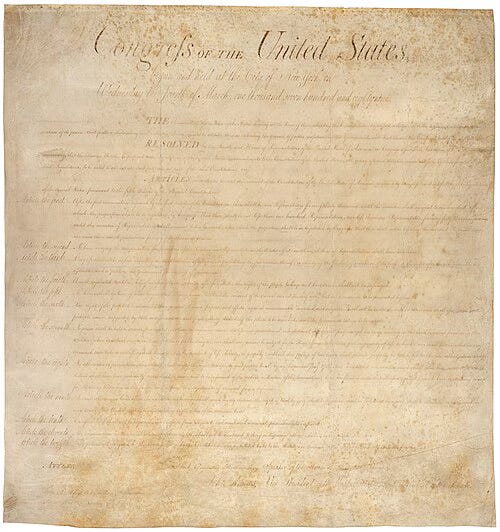
On December 15, 1791, the Bill of Rights was officially ratified, marking a foundational moment in American legal history. With Virginia becoming the crucial eleventh state to approve the measure, the first ten amendments to the U.S. Constitution achieved the three-fourths majority required for adoption. These amendments were crafted in response to fears that the newly formed federal government might trample on individual freedoms, a concern strongly voiced by the Anti-Federalists during the Constitution’s ratification debates. Drafted primarily by James Madison, the Bill of Rights was intended to secure essential civil liberties and limit government power.
The amendments enshrine core protections such as freedom of speech, religion, and the press, the right to bear arms, and safeguards against unreasonable searches and seizures. They also provide important rights to those accused of crimes, including the right to a fair trial, protection against self-incrimination, and freedom from cruel and unusual punishment. At the time, these provisions applied only to the federal government, but their scope was later expanded through the Incorporation Doctrine using the Fourteenth Amendment.
The ratification of the Bill of Rights represented a political compromise but ultimately became a defining element of American constitutional identity. Over the centuries, courts have invoked these amendments in countless rulings, from free speech cases to gun rights and due process protections. The Bill of Rights not only shapes modern legal debates but also remains a symbol of the nation’s enduring commitment to individual liberty and the rule of law. Its ratification on this day in 1791 continues to influence how justice is understood and delivered in the United States.
Judge Hannah Dugan of the Milwaukee County Circuit Court is on trial for allegedly obstructing an immigration arrest in her courtroom, a case seen as a test of Donald Trump’s aggressive immigration enforcement policies. Federal prosecutors accuse Dugan of helping a Mexican migrant, Eduardo Flores-Ruiz, evade arrest by redirecting ICE agents and escorting the defendant through a non-public exit after his hearing. Dugan, who has been suspended from the bench, has pleaded not guilty to charges of concealing a person from arrest and obstructing federal proceedings.
Prosecutors claim she acted corruptly and misled law enforcement, allegedly showing anger when she learned of ICE’s presence and insisting a judicial warrant was needed. Dugan’s defense argues she acted in good faith, following courthouse policy designed to handle ICE encounters after previous controversial arrests. The trial highlights growing legal and political tensions around courthouse arrests, which critics say intimidate immigrants and undermine trust in the legal system. The outcome could influence how far judges and local officials can go in pushing back against federal immigration actions.
Wisconsin judge faces trial for stopping courtroom arrest of migrant in Trump crackdown | Reuters
California filed a lawsuit against the Trump administration for cutting over $33 million in federal grants intended for commercial vehicle safety programs. The U.S. Department of Transportation, led by Secretary Sean Duffy, justified the funding termination by claiming California failed to properly enforce English proficiency requirements for truck drivers. California argues its standards align with federal rules and called the decision unlawful and harmful to public safety and the economy.
The lawsuit comes amid broader efforts by the Trump administration to crack down on non-English-speaking and non-U.S. citizen truck drivers. This includes halting commercial driver visas and threatening similar funding cuts in states like New York and Minnesota. The administration has also targeted Democrat-led states for other transportation-related penalties. In California’s case, the withheld funds were designated for safety inspections, audits, traffic enforcement, and education programs.
California contends that its licensed drivers are involved in significantly fewer fatal crashes than the national average, challenging the administration’s justification. The legal dispute reflects escalating tensions between federal agencies and Democratic states over immigration and transportation enforcement.
California sues Trump administration over terminated transportation grants | Reuters
A federal judge ruled that evidence seized from Daniel Richman, a former attorney for ex-FBI Director James Comey, was wrongfully retained by prosecutors, presenting a hurdle for any new charges against Comey. U.S. District Judge Colleen Kollar-Kotelly ordered the Department of Justice to return the files but allowed a sealed copy to remain with the court should prosecutors later obtain a valid warrant. Richman had filed a lawsuit claiming the DOJ had improperly held onto materials seized during an investigation that ended in 2021 without charges.
While the judge found the DOJ’s actions amounted to an unreasonable seizure, she declined to prevent the department from pursuing future leads based on the information already reviewed. The seized files had been used earlier this year to support an indictment against Comey, accusing him of making false statements and obstructing Congress over his 2020 testimony.
That indictment, along with one against New York Attorney General Letitia James, was dismissed last month after it was found the prosecutor involved had been unlawfully appointed. The judge’s ruling now complicates the DOJ’s ability to revive its case against Comey, a frequent critic of Donald Trump and a central figure in past investigations into Trump’s conduct.
Judge says Comey evidence was wrongfully retained, creating hurdle for new charges | Reuters
A California jury has ordered Johnson & Johnson to pay $40 million to two women who claimed its talc-based baby powder caused their ovarian cancer. The jury awarded $18 million to Monica Kent and $22 million to Deborah Schultz and her husband, finding the company failed to warn consumers despite allegedly knowing of the product’s risks for decades. Both women testified that they used the powder for over 40 years and have undergone extensive cancer treatments since their diagnoses in 2014 and 2018.
J&J denies the product causes cancer and plans to appeal the verdict, calling it an “aberrant” outcome. The company points out that no major U.S. health agency has definitively linked talc to ovarian cancer and argues that plaintiffs’ claims rely solely on legal arguments rather than scientific consensus.
This is the first talc trial to move forward since J&J’s latest bankruptcy attempt, aimed at resolving over 67,000 similar lawsuits, was rejected by the courts. The company previously stopped selling talc-based baby powder in the U.S. in 2020. While it has faced some large verdicts—including a $4.69 billion award in a past case—it has also won dismissals and reductions on appeal. In addition to ovarian cancer claims, J&J is also facing suits linking its talc products to mesothelioma, with some recent verdicts exceeding $900 million.
Jury orders Johnson & Johnson to pay $40 million to two women in latest talc trial | Reuters


