



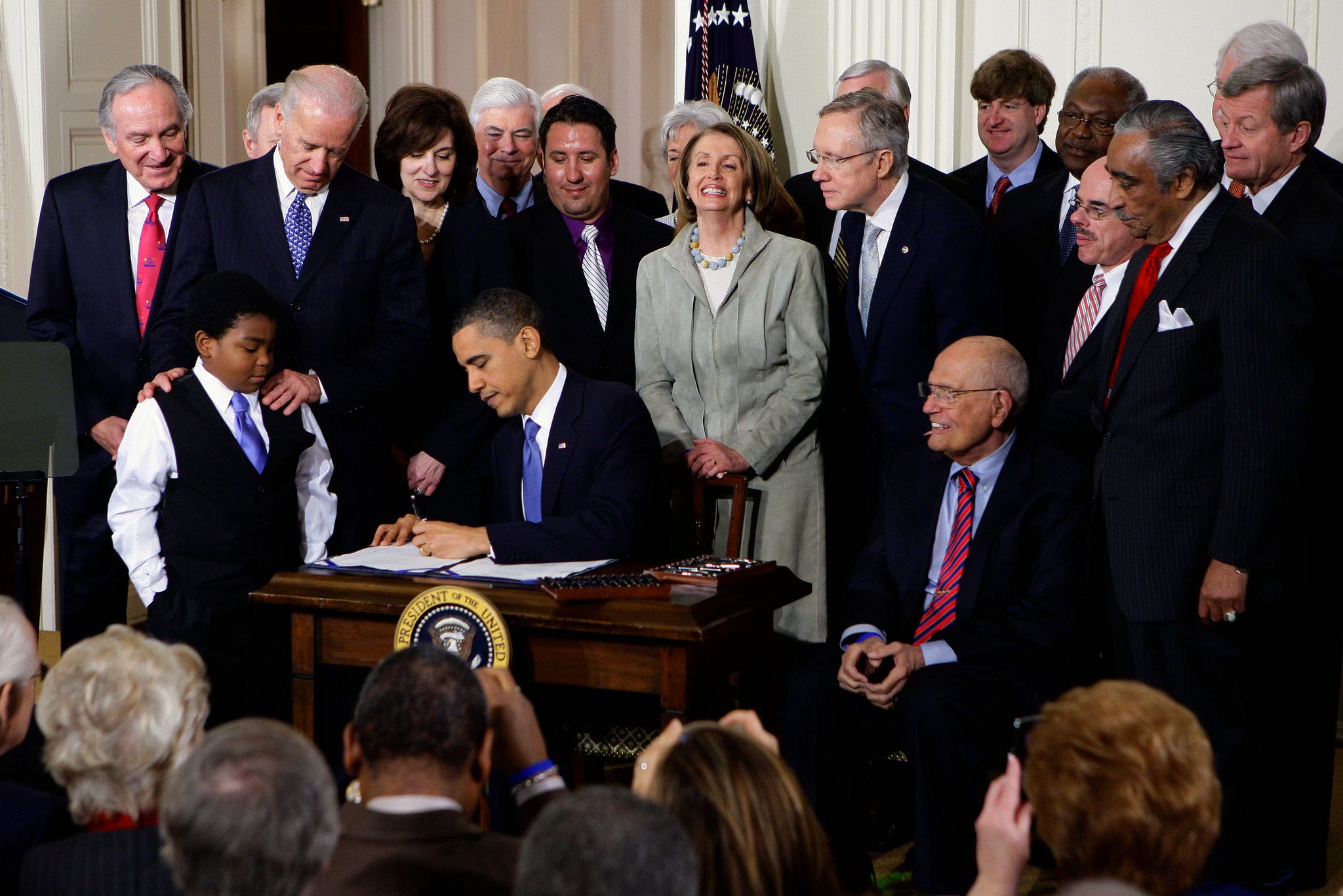
This Day in Legal History: ACA Signed into Law
On March 23, 2010, President Barack Obama signed into law the Patient Protection and Affordable Care Act, marking a transformative moment in American legal and social policy. The statute, widely known as the Affordable Care Act (ACA), sought to expand access to health insurance and reduce overall healthcare costs. Central to the law was the individual mandate, which required most Americans to obtain health insurance or face a financial penalty. The ACA also significantly expanded Medicaid eligibility, allowing millions of low-income individuals to gain coverage. Another key provision prohibited insurance companies from denying coverage based on preexisting conditions, reshaping longstanding industry practices.
Almost immediately after its passage, the law faced a wave of legal challenges from states, private parties, and advocacy groups. Critics argued that Congress had exceeded its authority under the Commerce Clause by compelling individuals to engage in commerce. The dispute reached the Supreme Court in the landmark case of NFIB v. Sebelius. In a closely divided decision, the Court held that the individual mandate could not be sustained under the Commerce Clause. However, Chief Justice John Roberts authored the controlling opinion that upheld the mandate as a valid exercise of Congress’s taxing power.
The Court also addressed the ACA’s Medicaid expansion, ruling that Congress could not coerce states into expanding coverage by threatening existing Medicaid funding. This aspect of the decision reinforced limits on federal power under the Spending Clause and preserved a degree of state sovereignty. The ACA continued to generate litigation in subsequent years, including challenges to its subsidy structure and individual mandate enforcement. Despite these legal battles, the law remains a central feature of the U.S. healthcare system. Its passage and judicial review reshaped modern constitutional interpretation, particularly regarding the balance between federal authority and individual liberty.
A California federal jury found that Elon Musk committed securities fraud in connection with his $44 billion attempt to acquire Twitter. After roughly 20 hours of deliberation, the jury concluded that two of Musk’s May 2022 tweets misled investors about the status of the deal and the prevalence of fake or spam accounts on the platform. In particular, his statement that the deal was “temporarily on hold” while awaiting bot data was deemed materially misleading. The jury also found liability for a later tweet suggesting bots made up at least 20% of users and that the deal could not proceed without proof.
However, jurors rejected the broader claim that Musk engaged in an overall scheme to defraud investors. They also declined to find liability for statements he made at a tech conference, determining those remarks were not proven to be fraudulent. The class of affected investors included those who traded Twitter stock or related options between May and October 2022 and claimed they suffered losses due to artificially depressed prices. While the jury did not calculate a final damages figure, plaintiffs’ counsel estimated potential damages at about $2.6 billion.
The verdict form instead required jurors to assess damages across 98 separate trading days, meaning total compensation will depend on individual trading activity. Plaintiffs’ attorneys characterized the decision as a win for market integrity, emphasizing that even high-profile figures must comply with securities laws. Musk’s legal team, by contrast, downplayed the outcome and indicated plans to appeal. The case featured testimony from Twitter executives, deal advisers, and co-founder Jack Dorsey, as well as disputes over whether Twitter accurately reported bot activity.
Jury Says Musk Defrauded Twitter Investors In $44B Buyout - Law360
The White House, under Donald Trump, released a legislative framework urging Congress to override state-level artificial intelligence regulations in favor of a single national standard. The administration argues that a patchwork of state laws creates unnecessary obstacles for innovation and weakens the United States’ ability to compete globally in AI development. At the same time, the proposal preserves certain areas of state authority, including laws addressing fraud, consumer protection, child safety, zoning, and state government use of AI.
The framework also addresses intellectual property concerns, recommending that courts continue to decide whether training AI systems on copyrighted material violates the law. It suggests Congress consider mechanisms that allow creators to collectively negotiate compensation from AI companies without triggering antitrust issues. Additionally, it calls for federal protections against unauthorized AI-generated replicas of individuals’ likeness, voice, or identity, while allowing exceptions for news and satire.
Another key focus is infrastructure, with proposals to prevent rising electricity costs from being passed on to consumers as AI data centers expand. The plan encourages faster federal permitting and supports alternative energy solutions to power AI development. It also includes provisions aimed at preventing government pressure on tech companies to censor speech and ensuring that federal data can be used to train AI systems.
The proposal has drawn mixed reactions. Industry groups and several Republican lawmakers praised the approach as promoting innovation through lighter regulation. In contrast, consumer advocates and Democratic lawmakers criticized it as favoring large technology companies while removing important state-level protections. Some Democrats have introduced legislation to block the initiative and preserve states’ authority to regulate AI.
White House Pushes Congress To Override State AI Laws - Law360 UK
The U.S. Supreme Court is hearing a case involving Mississippi’s law that allows certain mail-in ballots to be counted if they are postmarked by Election Day but arrive up to five business days later. The dispute stems from a challenge brought by Republican groups, including the Republican National Committee, which argue that the law conflicts with federal election statutes. The Trump administration is supporting this challenge, continuing its broader push to restrict mail-in voting.
Mississippi enacted the rule in 2020, during the COVID-19 pandemic, with bipartisan support. It applies to limited categories of voters, such as the elderly, disabled individuals, and those temporarily away from home. However, in 2024, the U.S. Court of Appeals for the Fifth Circuit ruled that the law likely violates federal law, which it interpreted as requiring ballots to be both cast and received by Election Day. The court concluded that states cannot extend the deadline for receiving ballots beyond that date.
The Supreme Court is now reviewing Mississippi’s appeal of that decision, with potentially broad implications. Roughly 30 states and Washington, D.C. have similar policies that count ballots arriving after Election Day if they were mailed on time. A ruling against Mississippi could therefore force significant changes to voting procedures nationwide and limit the use of mail-in ballots.
The case also reflects ongoing political disputes over election integrity and access to voting. Republicans have raised concerns about the security of mail-in ballots, while critics argue that restrictions could reduce voter participation. The outcome of this case may clarify how federal election law interacts with state authority over voting procedures.
US Supreme Court weighs Republican bid to limit mail-in voting | Reuters


