



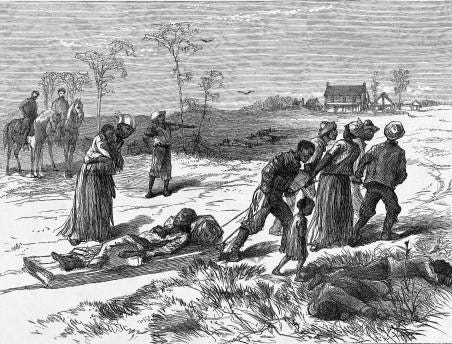
This Day in Legal History: Colfax Massacre
On April 13, 1873, one of the most violent and legally significant event of the Reconstruction era unfolded in Louisiana with the Colfax Massacre. The conflict arose from a disputed gubernatorial election, as competing groups claimed control of local government in Grant Parish. Black citizens, many of them formerly enslaved, gathered at the courthouse in Colfax to defend the Republican-backed election outcome. White supremacist militias, determined to overturn Reconstruction governments, attacked the courthouse with overwhelming force. By the end of the confrontation, dozens of Black men had been killed, many after surrendering, making it one of the deadliest incidents of racial violence during Reconstruction.
In the aftermath, federal prosecutors sought to hold members of the attacking group accountable under the Enforcement Acts, which were designed to protect the civil rights of newly freed citizens. These prosecutions led to the landmark Supreme Court case United States v. Cruikshank. The Court ultimately overturned the convictions, ruling that the federal government’s authority to prosecute such crimes was limited. It held that the Fourteenth Amendment constrained only state actions, not the conduct of private individuals. This interpretation sharply narrowed the scope of federal power to intervene in cases of racial violence and civil rights violations.
The decision effectively left Black citizens in the South vulnerable to attacks by private groups, as state authorities were often unwilling to prosecute perpetrators. It also signaled a broader retreat from Reconstruction policies, undermining efforts to enforce equality through federal law. For decades, this ruling stood as a major barrier to civil rights enforcement, shaping the legal landscape well into the twentieth century. The legacy of Colfax and Cruikshank illustrates how judicial interpretation can either strengthen or weaken constitutional protections, particularly during periods of social and political upheaval.
U.S. Immigration and Customs Enforcement (ICE) has launched a new initiative aimed at investigating so-called “birth tourism” networks. These are groups that allegedly help pregnant foreign nationals enter the United States on temporary visas with the goal of giving birth so their children obtain U.S. citizenship. The effort is part of a broader immigration crackdown under President Donald Trump’s administration, which has emphasized stricter controls on both legal and illegal immigration.
An internal ICE directive instructs agents to identify fraud and organized operations that may be facilitating these activities. While giving birth in the U.S. is not illegal, authorities are focusing on potential misuse of visas and false statements in applications. A 2020 regulation already bars individuals from using tourist visas primarily for the purpose of securing citizenship for a child, meaning violations could lead to fraud charges.
The administration has also used birth tourism as a justification for attempting to limit birthright citizenship, a right grounded in the Fourteenth Amendment. Trump issued an executive order seeking to deny citizenship to children born in the U.S. to non-citizen parents, but multiple courts have blocked the policy, and the issue is now before the Supreme Court. Government lawyers argue that birthright citizenship has encouraged an industry built around these practices, though data suggests such cases represent only a small fraction of total U.S. births.
ICE’s initiative will focus on uncovering fraud and dismantling organized networks, similar to past prosecutions involving “birth houses” that catered to foreign clients. However, the overall scale of birth tourism remains unclear, and officials have not indicated how many cases they expect to pursue.
Exclusive: ICE launches new effort to uncover US ‘birth tourism schemes’ | Reuters
The Massachusetts Supreme Judicial Court ruled that Meta Platforms must face a lawsuit brought by Massachusetts Attorney General Andrea Joy Campbell. The lawsuit claims that Instagram was intentionally designed to be addictive for children and teenagers. This decision is significant because it is the first time a state high court has addressed whether Section 230 of the Communications Decency Act can shield a company from claims focused on platform design rather than user-generated content.
The court unanimously found that the case can proceed because it targets Meta’s own conduct, not the content posted by users. Specifically, the lawsuit argues that Instagram’s features—such as notifications, “likes,” and endless scrolling—exploit young users’ psychological vulnerabilities. It also alleges that Meta misled the public about the platform’s safety and ignored internal research showing harm to teenagers.
Meta disagrees with the ruling and maintains that the distinction between content and design is flawed, expressing confidence it will ultimately prevail. Meanwhile, the decision is part of a broader wave of litigation across the United States, with multiple states and plaintiffs accusing social media companies of contributing to a youth mental health crisis. Some recent cases have already resulted in significant financial penalties and verdicts against Meta and similar companies.
Meta must face youth addiction lawsuit by Massachusetts, court rules | Reuters
You’re getting a double dose of Meta today, with a second development tied to the growing wave of social media addiction litigation.
Meta Platforms announced it will remove advertisements on Facebook and Instagram that were being used by law firms to recruit plaintiffs for lawsuits alleging its platforms are addictive to young users. The company said it is actively defending itself in thousands of ongoing cases and does not want attorneys using its services to find clients while simultaneously arguing those platforms are harmful. This move comes shortly after major courtroom setbacks, including jury verdicts that ordered Meta to pay millions in damages tied to alleged harms from youth social media use.
The broader litigation landscape is large and still expanding. Thousands of cases are pending in both state and federal courts, many involving claims that platforms like Instagram were designed to encourage compulsive use and contributed to mental health issues among minors. Plaintiffs include individuals as well as public entities like school districts and states, which argue they have had to spend resources addressing the effects of social media on young people. Meta and other tech companies deny these allegations and maintain they have taken steps to improve user safety.
The ads at issue are part of a common practice in mass tort litigation, where law firms seek out large numbers of plaintiffs to build cases. These firms often work on contingency, meaning they only get paid if they win or settle, which creates an incentive to recruit clients through widespread advertising. Some attorneys criticized Meta’s decision, arguing that blocking ads could make it harder for potential victims to learn about their legal options.
Meta pulls ads aimed at recruiting plaintiffs for social media addiction lawsuits | Reuters


