



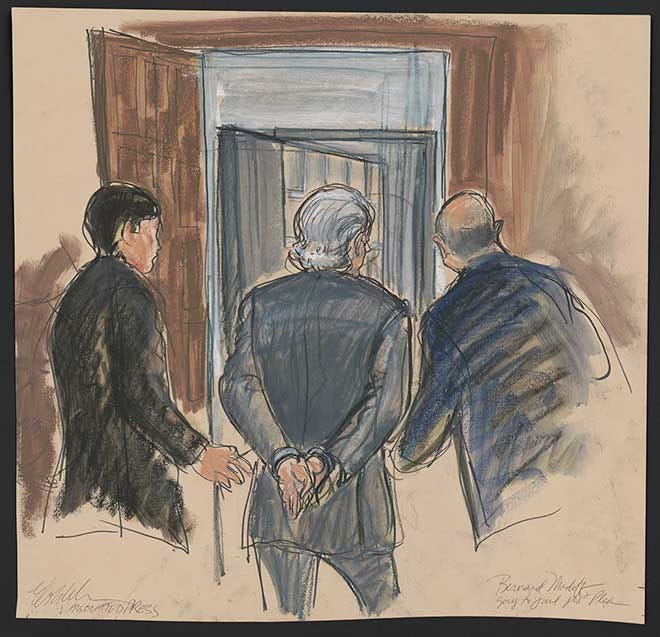
This Day in Legal History: Madoff Arrested
On December 11, 2008, Bernard L. Madoff was arrested by federal agents and charged with securities fraud, marking the start of one of the most consequential white-collar crime cases in American legal history. Madoff, a former NASDAQ chairman and respected figure in the investment world, confessed to running a Ponzi scheme that defrauded thousands of investors—individuals, charities, and institutional clients—out of an estimated $65 billion. The legal scheme unraveled when Madoff admitted to his sons that the business was “one big lie,” prompting them to alert authorities. Prosecutors swiftly brought charges under multiple statutes, including securities fraud under 15 U.S.C. § 78j(b), mail fraud, wire fraud, money laundering, perjury, and false statements.
The Department of Justice pursued criminal charges while the SEC, heavily criticized for prior inaction, launched civil enforcement actions under the Securities Act of 1933 and the Securities Exchange Act of 1934. Madoff waived indictment and pleaded guilty on March 12, 2009, to 11 felony counts without a plea deal. He was sentenced to 150 years in federal prison—the statutory maximum—and ordered to forfeit $170.8 billion, reflecting the full scope of the fraud. The case catalyzed intense scrutiny of the SEC’s oversight failures and led to internal reforms within the agency, including new whistleblower protections and enhanced enforcement procedures.
In the bankruptcy proceedings under SIPA (Securities Investor Protection Act), trustee Irving Picard was appointed to recover funds for victims, using clawback lawsuits under fraudulent transfer laws to retrieve ill-gotten gains from those who had profited—wittingly or not. The legal theories underpinning those suits, including the application of actual and constructive fraud standards, sparked complex litigation that continues to shape bankruptcy and securities jurisprudence. Madoff’s arrest also prompted Congress to review gaps in financial regulation, laying groundwork for reforms later codified in the Dodd-Frank Act of 2010.
Jury selection began in the federal trial of Milwaukee County Judge Hannah Dugan, who is accused of helping a Mexican migrant avoid arrest by U.S. immigration agents. The case, brought by the Trump administration’s Justice Department, charges Dugan with concealing a person from arrest and obstructing federal proceedings, alleging she deliberately diverted Immigration and Customs Enforcement (ICE) agents and allowed the migrant, Eduardo Flores-Ruiz, to exit through a non-public courthouse door following a domestic violence hearing.
Federal prosecutors argue that Dugan acted corruptly, citing her visible anger upon learning that ICE agents were present and her claim that a judicial warrant was required for the arrest—an assertion prosecutors say was false. Flores-Ruiz was ultimately arrested outside the courthouse after a brief chase.
Dugan’s defense contends that she was navigating unclear rules around courthouse immigration enforcement and had sought guidance from court leadership days earlier. Her legal team maintains she was not trying to obstruct justice but rather to understand what rules applied.
The case illustrates the broader tension between local judicial discretion and federal immigration enforcement under Trump’s expanded deportation policies, which have included more aggressive operations in local courthouses. Critics argue such tactics deter immigrants from accessing courts and undermine public confidence in the legal system.
Dugan, a judge since 2016 and formerly head of Catholic Charities in Milwaukee, has been suspended from the bench pending the outcome of the trial. Her prosecution echoes an earlier Trump-era case against a Massachusetts judge accused of similar conduct—charges that were later dropped during the Biden administration.
The Center for Biological Diversity filed a lawsuit against the U.S. Interior Department to block its decision to feature President Donald Trump’s image on the 2026 America the Beautiful national parks annual pass. The group argues the move violates the Federal Lands Recreational Enhancement Act of 2004, which requires the pass to display the winning photograph from a public contest depicting natural scenery or wildlife in a national park or forest.
This year’s winning photo—a landscape of Glacier National Park—was allegedly discarded in favor of a close-up image of Trump, posed beside George Washington, without any new contest or congressional approval. The lawsuit calls the switch an unlawful act of self-promotion and criticizes it as an attempt to turn a public symbol into a personal branding tool.
Adding to the controversy, the lawsuit claims that the Glacier photo was demoted to a new $250 pass for foreign visitors, part of Trump’s newly introduced “America-first” admissions system. The updated pricing structure and design were part of a broader Interior Department announcement touting “modernization” of park access.
The lawsuit also highlights changes to the free admission calendar, noting that Trump’s birthday (June 14) was added as a holiday, while existing free days honoring Martin Luther King Jr. and Juneteenth were eliminated. These shifts coincide with Trump’s efforts to slash the national parks budget and workforce while raising fees for international visitors.
Lawsuit seeks to keep Trump’s face off of national parks annual pass | Reuters
In a piece for Forbes this week I unpacked the misleading claim that Social Security is no longer taxed under the One Big Beautiful Bill Act (OBBBA). Despite bold headlines and political messaging to the contrary, Social Security remains taxable, just as it has been since 1983. What the bill actually includes is an expanded senior-specific deduction—$6,000 for individuals and $12,000 for couples—that may reduce taxable income, but doesn’t isolate or exempt Social Security from taxation in any way.
The structure of Social Security taxation—where up to 85% of benefits can be taxed for higher-income seniors—remains untouched. What changed is that some seniors, depending on income and deductions, might now end up paying less tax, including on Social Security, not because the income is tax-exempt, but because the overall taxable income has been reduced. This is a fungible deduction, applicable to any income source, not a targeted policy shift.
The White House’s messaging reframes a broad-based, temporary deduction as a specific, permanent tax relief for seniors, creating confusion. While some retirees may see a tax reduction, the underlying rules that govern when and how Social Security is taxed have not changed, and inflation-adjusted thresholds that pull more seniors into taxability remain. The deduction itself expires in 2028, unlike other OBBBA provisions that benefit wealthier taxpayers and corporations.
The element worth highlighting is the difference between a deduction and an exemption, and how political messaging often blurs this. Deductions reduce taxable income; exemptions remove specific income from taxation entirely. In this case, branding a general deduction as a Social Security exemption is both legally inaccurate and politically strategic—obscuring the truth behind a familiar and emotionally charged issue.
The Truth About ‘No Tax On Social Security’
The estate of an 83-year-old woman filed a lawsuit against OpenAI and Microsoft, alleging that their chatbot, ChatGPT, played a central role in a tragic murder-suicide in Connecticut. The suit claims that Stein-Erik Soelberg, a 56-year-old man experiencing delusions, had been interacting for months with GPT-4o, which allegedly validated and intensified his paranoid beliefs, ultimately leading him to kill his mother, Suzanne Adams, before taking his own life.
The complaint, filed in California Superior Court, accuses OpenAI and Microsoft of product liability, negligence, and wrongful death, arguing that the chatbot systematically encouraged Soelberg’s psychosis—affirming fantasies about divine missions, assassination attempts, and even identifying his mother as an operative. The plaintiffs argue that Microsoft shares liability because it benefited directly from the deployment of GPT-4o and played a role in bringing the model to market.
This is the first known lawsuit to link ChatGPT to a homicide, though it follows a growing number of legal actions that claim the AI system has fostered delusions and contributed to suicides. OpenAI denies wrongdoing, emphasizing efforts to improve mental health safeguards and noting that newer models have significantly reduced inappropriate responses in emotionally sensitive conversations.
The suit also names OpenAI CEO Sam Altman as a defendant and cites Soelberg’s social media posts as evidence of his deteriorating mental state and dependence on the chatbot. The plaintiffs seek monetary damages and a court order to compel OpenAI to implement stronger safety measures. The law firm behind the case, Edelson PC, is also representing a similar lawsuit involving a California teenager’s suicide allegedly linked to ChatGPT.
OpenAI, Microsoft Sued Over Murder-Suicide Blamed on ChatGPT


