



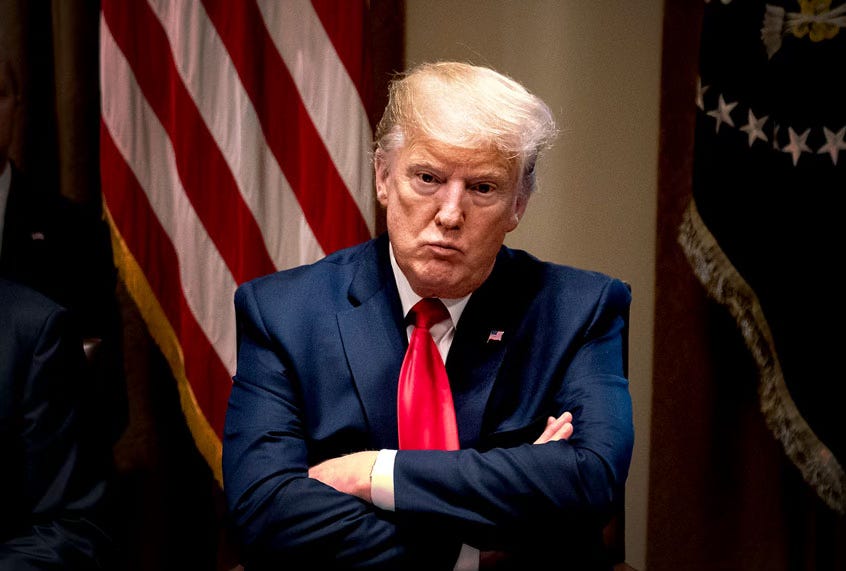
This Day in Legal History: Trump Impeached
On December 18, 2019, the U.S. House of Representatives voted to impeach President Donald J. Trump, marking the third presidential impeachment in American history. The impeachment followed a months-long investigation centered on Trump’s dealings with Ukraine. House Democrats alleged that the president abused the powers of his office by pressuring a foreign government to investigate a political rival. A second article charged Trump with obstruction of Congress for directing executive branch officials not to comply with House subpoenas. The votes largely split along party lines, reflecting deep political polarization.
Impeachment itself did not remove Trump from office, but instead formally accused him of constitutional wrongdoing. Under the Constitution, the House holds the sole power of impeachment, functioning similarly to a grand jury. Once impeached, the process shifted to the Senate, which is responsible for conducting a trial. Chief Justice John Roberts later presided over the Senate proceedings, as required when a president is tried. The Senate ultimately acquitted Trump in February 2020, falling short of the two-thirds vote needed for conviction. Despite the acquittal, the impeachment reinforced Congress’s oversight authority over the executive branch. The episode also highlighted ongoing debates about the limits of presidential power and the role of impeachment as a constitutional check.
A federal appeals court in Washington reversed an earlier ruling that would have allowed the Trump administration to move forward with mass firings at the Consumer Financial Protection Bureau (CFPB). Sitting as a full bench, the court blocked plans to cut as much as 90% of the agency’s workforce and agreed to rehear the administration’s appeal of a lower court order that had paused efforts to dismantle the bureau. As a result, the administration remains temporarily barred from gutting the agency while litigation continues. The legal fight has stretched on for months, during which the CFPB has been largely sidelined. Congress originally created the CFPB after the 2008 financial crisis to protect consumers from unfair, deceptive, and abusive practices by banks, lenders, and other financial companies. Its mission includes enforcing federal consumer financial laws and preventing the kinds of predatory conduct that helped trigger the financial collapse. Supporters of the agency, including Senator Elizabeth Warren, praised the ruling as necessary to shield families from financial harm.
Critics within the Trump administration have argued the CFPB is politically motivated (as protecting consumers from predatory financial practices is political, apparently) and should be eliminated, though they have also claimed in court that some version of the agency would remain. Complicating matters further, the CFPB faces a funding dispute over whether it can draw money from the Federal Reserve, raising concerns that it could run out of operating funds.
US appeals court tosses decision allowing Trump mass firings at consumer bureau | Reuters
Full DC Circuit Will Review Trump’s Bid to Dismantle CFPB (2)
A group of leading medical organizations asked a federal judge to allow their lawsuit challenging vaccine policy changes under Health Secretary Robert F. Kennedy Jr. to move forward. The groups argue that recent actions by Kennedy and the Department of Health and Human Services will reduce vaccination rates and endanger public health. They point to a directive removing COVID-19 vaccine recommendations for pregnant women and children without advance notice or explanation. The lawsuit also challenges Kennedy’s decision to dismiss 17 experts from a CDC advisory panel and replace them with members more aligned with his views. That reconstituted panel later voted to scale back broad vaccine recommendations, including limiting COVID-19 shots to shared decision-making with doctors and eliminating universal recommendations for certain childhood vaccines.
The plaintiffs claim the panel was unlawfully reshaped in violation of federal law requiring advisory committees to be balanced and free from improper influence. Government lawyers argue the medical groups lack standing because the CDC’s guidance merely advises consultation with doctors and does not directly harm them. The plaintiffs counter that they have been injured by having to divert resources to help doctors navigate confusing and abrupt policy shifts. The judge indicated skepticism toward the government’s standing argument, particularly in light of statements suggesting doctors could face liability for deviating from CDC guidance. A ruling on whether the case can proceed is expected before a scheduled January hearing.
A federal appeals court allowed President Donald Trump’s deployment of National Guard troops in Washington, D.C., to remain in place while legal challenges continue. A three-judge panel said the administration was likely to succeed in defending the deployment, temporarily blocking a lower court order that would have ended it. The ruling gives Trump an interim victory as he claims broad authority to use troops for domestic law enforcement. The deployment began earlier in the year and expanded after two Guard members were shot near the White House. The judges emphasized that Washington, D.C.’s unique status—because it is not a state—strengthens presidential authority there. District officials who sued to stop the deployment said the decision is preliminary and does not resolve the underlying legal questions. The White House praised the ruling as confirmation of the president’s lawful powers and credited the deployment with improving public safety. The case comes amid broader disputes over Trump’s efforts to deploy troops in several major cities despite objections from local and state leaders. Lower courts have generally been skeptical of those efforts, rejecting claims that protests against federal immigration enforcement qualify as rebellions. The Supreme Court is widely expected to weigh in on the scope of presidential power in this area.
US appeals court says Trump’s National Guard deployment in DC may continue | Reuters
Trump’s DC Troop Deployment Gets Extension From US Appeals Court
A federal judge allowed President Donald Trump to continue work on a proposed White House ballroom, rejecting an emergency request from preservation advocates to immediately halt the project. The judge ruled that the National Trust failed to show imminent, irreparable harm that would justify stopping construction at this early stage. However, he cautioned that the government may be required to reverse certain underground work if it ends up locking in a specific design. The project involves replacing the demolished East Wing with a large ballroom that would be significantly bigger than prior White House renovations. Trump has described the ballroom as a privately funded project and recently increased its estimated cost. Preservationists argue the administration moved forward without required public input and bypassed federal planning and design review processes. The government countered that the design is still in flux and that above-ground construction will not begin for several months. Relying on those representations, the judge found no immediate risk of irreversible aesthetic damage. He scheduled another hearing to reconsider whether the project should be paused as the lawsuit continues. For now, construction may proceed while the court reviews whether the administration complied with historic preservation and planning laws.
Judge allows Trump’s ballroom project to proceed for now | Reuters


