



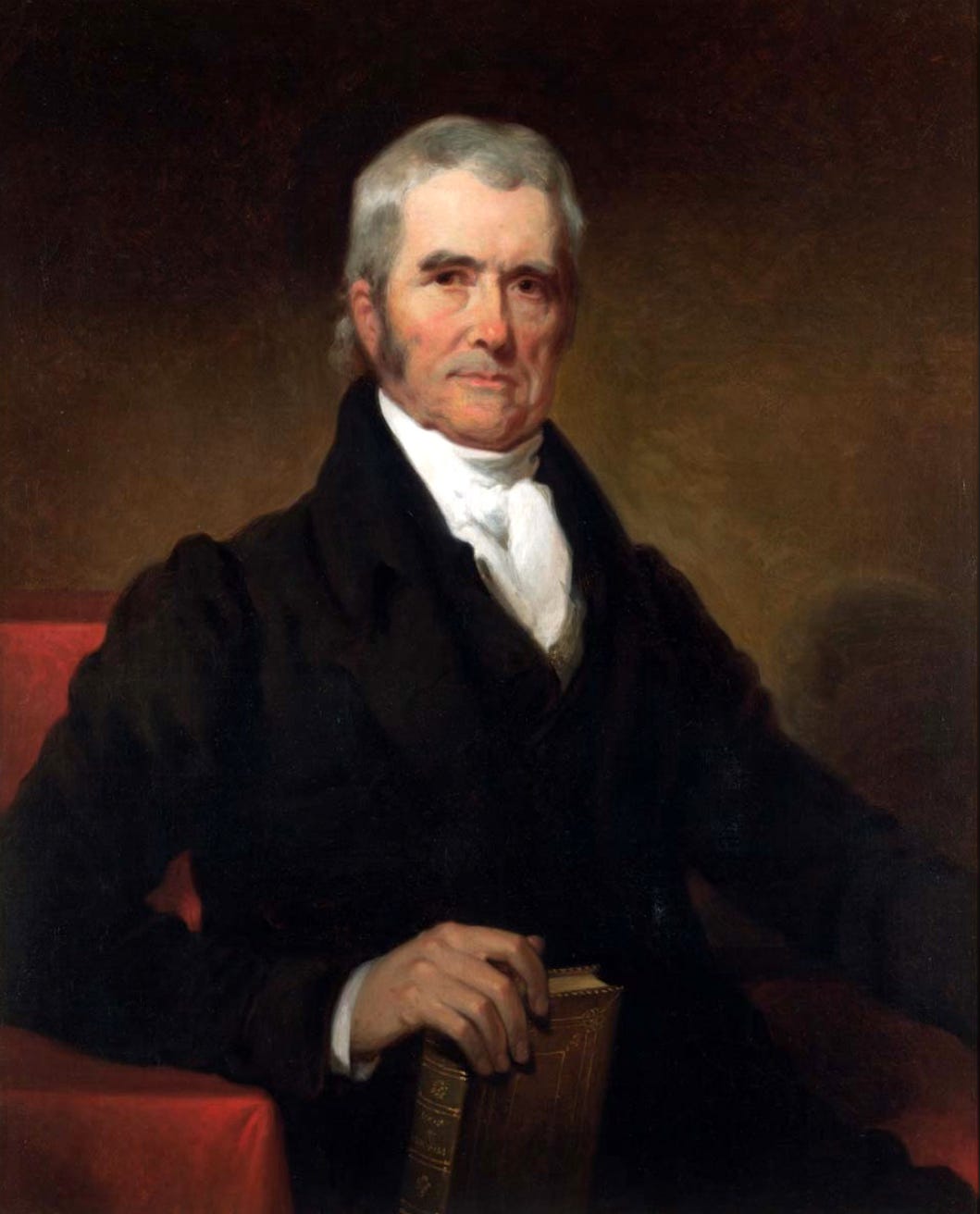
This Day in Legal History: Marbury v. Madison
On February 24, 1803, the U.S. Supreme Court decided Marbury v. Madison, a case that permanently reshaped American constitutional law. The dispute arose after President John Adams appointed several “midnight judges” in the final hours of his administration. One of those appointees, William Marbury, never received his commission because it was not delivered before Thomas Jefferson took office. Jefferson instructed his Secretary of State, James Madison, not to deliver the commission, prompting Marbury to seek relief directly from the Supreme Court.
Presiding over the case was Chief Justice John Marshall, whose involvement added a striking layer of irony. Before becoming Chief Justice, Marshall had served as Secretary of State under Adams and had been responsible for sealing the very commissions at issue. In other words, Marshall was now reviewing the legal consequences of actions taken by his former office. Rather than recuse himself, he authored the opinion that would define the Court’s authority.
Marshall concluded that Marbury had a legal right to his commission but held that the statute granting the Supreme Court power to issue writs of mandamus conflicted with Article III of the Constitution. Because the Constitution is the supreme law of the land, Marshall reasoned, any conflicting statute must be void. In declaring part of the Judiciary Act of 1789 unconstitutional, the Court asserted the power of judicial review for the first time.
The decision simultaneously denied Marbury his remedy while expanding the Court’s institutional authority. It avoided a direct political confrontation with Jefferson while firmly establishing the judiciary as a co-equal branch of government. What began as a minor political dispute over an undelivered commission became the foundation for the Supreme Court’s power to strike down unconstitutional laws.
A federal judge has permanently blocked the Justice Department from releasing a prosecutor’s report concerning the classified documents case against President Donald Trump. The ruling was issued by U.S. District Judge Aileen Cannon, who concluded that making the report public would amount to a “manifest injustice” because the case never went to trial. She reasoned that publishing detailed allegations of criminal conduct without a jury verdict would undermine basic fairness principles.
The case had been brought by Special Counsel Jack Smith and accused Trump of unlawfully retaining sensitive national defense materials at his Mar-a-Lago property and obstructing government efforts to recover them. Trump and his co-defendants, Walt Nauta and Carlos de Oliveira, pleaded not guilty and described the prosecution as politically motivated. In 2024, Cannon dismissed the charges, finding that Smith had not been lawfully appointed.
After Trump returned to office, the Justice Department supported efforts to keep the report confidential. Although special counsels are typically required to submit reports explaining their charging decisions, Cannon held that releasing this one would conflict with her earlier rulings, including her determination that Smith’s appointment was invalid. She also cited concerns about exposing grand jury material.
The decision prevents public disclosure of substantial details about one of the four criminal cases Trump faced after leaving office. It follows the Supreme Court’s recent decision limiting Trump’s tariff authority and marks another significant legal development in the ongoing disputes surrounding his post-presidency investigations.
US judge permanently blocks release of report on Trump documents case | Reuters
The chief judges of two major federal appeals courts have announced plans to step back from active service later this year, creating new vacancies for President Donald Trump to fill. Debra Ann Livingston of the U.S. Court of Appeals for the Second Circuit and Jeffrey Sutton of the U.S. Court of Appeals for the Sixth Circuit both notified the president that they intend to take senior status. Livingston plans to assume senior status on July 1, while Sutton will do so on October 1.
Their decisions come ahead of the November midterm elections, when control of the U.S. Senate could shift, potentially complicating confirmation of successors. Because judicial vacancies have been relatively scarce during Trump’s second term, the openings present an opportunity to expand his appellate appointments. During his first term, Trump appointed 54 appellate judges, significantly influencing the judiciary’s ideological direction.
Both judges were originally appointed by President George W. Bush. Livingston, who has served on the Second Circuit since 2007 and became chief judge in 2020, has at times issued notable dissents, including in cases involving LGBTQ workplace protections and congressional subpoenas tied to Trump’s business records. Sutton, on the Sixth Circuit since 2003 and chief judge since 2021, has been an influential conservative jurist. He authored a 2014 opinion upholding same-sex marriage bans that the Supreme Court later overturned in Obergefell v. Hodges.
Senior status allows eligible judges to continue hearing cases on a reduced basis while enabling the president to nominate full-time replacements. Their departures will hand Trump two high-profile appellate vacancies at a time when few others are available.
Two chief US appellate judges to leave active service, handing Trump vacancies | Reuters
In my weekly column for Bloomberg Tax, I examine the Trump administration’s proposed 0.125% “land port maintenance tax” and question whether it is truly infrastructure policy or contingency planning after the Supreme Court curtailed its tariff authority. The proposal is framed as a parity measure to mirror the Harbor Maintenance Fee, but I argue the timing is hard to ignore. Just this week, the Court in Learning Resources Inc. v. Trump held that the International Emergency Economic Powers Act does not authorize the president to impose tariffs, reaffirming that Congress controls taxing power absent clear delegation. In my view, that ruling narrows executive trade authority and invites efforts to find alternative mechanisms embedded elsewhere in the customs code.
I suggest the land port tax looks like one such alternative. Although labeled a “maintenance” fee, it would be imposed at the border and function economically like a tariff, with costs passed to US importers and consumers. Because most land-based trade flows through Canada and Mexico, I note that the charge would operate in practice as a North American supply chain tax. Calling it infrastructure policy does not change its price effects.
I also argue that the Harbor Maintenance Fee analogy falls apart on inspection. Whatever its flaws, the HMF at least carries a user-fee logic tied to dredging and port upkeep. By contrast, the new proposal appears loosely connected to land-border infrastructure and bundled within a broader maritime industrial policy agenda. If shipbuilding is a national security priority, I contend Congress should fund it transparently through the Defense Department and regular appropriations. If the HMF distorts shipping routes, it should be reformed directly rather than replicated inland.
Ultimately, I maintain that after Learning Resources, any border charge that operates like a tariff will face legal skepticism. If policymakers intend to subsidize maritime industry, they should say so clearly, define measurable goals, and subject the costs to democratic accountability.


