



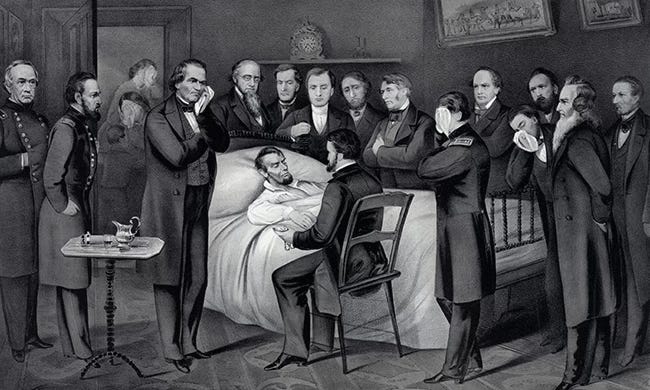
This Day in Legal History: Lincoln is Shot at Ford’s Theatre
On April 14, 1865, Abraham Lincoln was shot at Ford’s Theatre by John Wilkes Booth, an act that would alter the trajectory of Reconstruction and American legal history. Lincoln’s life story makes the moment even more striking: born in poverty in a Kentucky log cabin, largely self-educated, and rising through persistence rather than privilege, he embodied a form of democratic possibility rare among world leaders. Over time, his legal and political thinking evolved in meaningful ways, particularly on questions of equality and civil rights. While early in his career he held more limited views, the Civil War years reshaped his outlook, pushing him toward support for Black suffrage and, by some accounts, openness to broader enfranchisement, including for women.
Frederick Douglass, who met with Lincoln during the war, captured this complexity well, noting that Lincoln was “preeminently the white man’s President,” yet also “the first to show any respect for the rights of the black man.” Douglass emphasized that Lincoln’s greatness lay not in perfection, but in growth—his capacity to move, under pressure and moral reflection, toward justice. By April 1865, Lincoln was publicly advocating limited Black voting rights, particularly for Black soldiers and educated men, a position that suggested further expansion might follow in his second term.
That possibility was cut short on the night of April 14, when Booth entered the presidential box during a performance and fired a single shot at close range. Lincoln died the following morning, and with him vanished a moderating but increasingly progressive force in Reconstruction policy. In the years that followed, many of the shortcomings we associate with Reconstruction—including the narrowing of federal protections seen in cases like United States v. Cruikshank—took hold in a political environment Lincoln never had the chance to shape. His assassination opened the door to a more fractured and often less protective approach to civil rights enforcement.
A little-known but striking footnote to this story involves Edwin Booth, the brother of Lincoln’s assassin, who months earlier had unknowingly saved the life of the president’s son, Robert Todd Lincoln. At a crowded train platform in Jersey City, Robert slipped and fell between the train and the platform just as the car began to move. Edwin Booth, standing nearby, quickly grabbed him by the collar and pulled him to safety, preventing what could have been a fatal accident. The two men did not recognize each other at the time, and Booth only later learned whose life he had saved. The incident has since taken on a symbolic quality in legal and historical writing, illustrating the strange intersections of fate surrounding the Lincoln family in the days leading up to April 1865.
Legally and historically, April 14 stands as a hinge moment: not only the loss of a president, but the loss of a developing constitutional vision. Lincoln’s trajectory suggests that Reconstruction might have unfolded differently under his continued leadership, particularly on voting rights and federal protection of equality. Douglass later reflected that Lincoln’s legacy should be judged not by where he began, but by how far he traveled. That journey—from humble origins to an evolving commitment to equality—remains central to understanding both the promise and the unfinished work of American law.
After his death, Abraham Lincoln’s body was carried on a funeral train that retraced, in reverse, the route he had taken to Washington as president-elect in 1861, passing through many of the same stations and drawing massive crowds at every stop. The train’s journey from Washington, D.C. to Springfield became a rolling national mourning, with citizens lining the tracks to pay their respects to the fallen leader. In a deeply symbolic sense, the trip marked the completion of Lincoln’s final journey—returning him to the place where his political life had taken root, even as the nation he led struggled to carry forward the work he unwittingly left unfinished.
President Donald Trump announced plans to nominate Matthew Schwartz, his personal lawyer in the New York hush money case, to the U.S. Court of Appeals for the Second Circuit. Schwartz is a longtime partner at Sullivan & Cromwell LLP and joined Trump’s legal team in 2025 to handle the appeal after prior attorneys moved into government roles. Trump praised Schwartz as a strong opponent of government overreach and highlighted his experience in high-level federal and state litigation. In addition to the criminal appeal, Schwartz is also representing Trump in a civil fraud case brought by Letitia James, where his team recently urged the state’s highest court to dismiss the claims as politically motivated. Schwartz previously clerked for Samuel Alito and worked at Cravath Swaine & Moore LLP, and he is a graduate of Columbia Law School.
Trump Taps Personal Attorney for Second Circuit
An Illinois jury in Cook County added $17 million in punitive damages to an earlier $53 million award against Abbott Laboratories in a case brought by four mothers whose premature infants developed necrotizing enterocolitis after being fed the company’s formula. The jury previously found in favor of the plaintiffs on claims including failure to warn, negligence, and product defect, awarding individual damages based on the harm suffered by each child, all of whom survived but face lasting health complications.
Plaintiffs argued they were not informed of the risks associated with the formula and would have made different feeding decisions had they known. Abbott disputed liability, maintaining that its products are safe and that scientific evidence does not support a causal link between its formula and the condition, and said it plans to appeal. The trial judge allowed punitive damages after finding evidence the company may have withheld risk information, and also criticized testimony suggesting mothers should not be told about such risks. The case is part of broader, ongoing litigation over infant formula, with mixed outcomes in courts across the country.
Ill. Jury Adds $17M Punitive Award To Baby Formula Verdict - Law360
In my column for Bloomberg this week, I argue that new IRS guidance on opportunity zones largely revives the original program from the Tax Cuts and Jobs Act without addressing its core flaws—and may even worsen them. While the framework still aims to direct private capital into distressed communities through tax incentives, the updated rules expand where zones can be drawn and lower investment thresholds, particularly in rural areas. In practice, that means more projects will qualify, but fewer are likely to deliver the kind of transformative impact the policy was designed to achieve.
The first iteration showed that investment tended to flow toward already developing areas with stronger returns, not the communities most in need, and the new guidance does little to change that incentive structure. Governors retain broad discretion in selecting zones, a feature that previously led to politically influenced designations rather than data-driven ones. By easing standards like the “substantial improvement” requirement, the revised rules make it easier for incremental upgrades—not meaningful redevelopment—to receive tax benefits. As a result, the program risks continuing to function more as a subsidy for already viable projects than as a tool for economic revitalization. I suggest that a more effective approach would tie both zone designation and tax benefits to measurable outcomes like housing growth, job creation, or business investment, while reducing discretionary selection in favor of objective economic criteria.


