



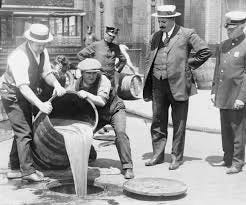
This Day in Legal History: 18th Amendment to the US Constitution
On January 16, 1919, the 18th Amendment to the United States Constitution was ratified, marking a pivotal moment in American legal history by establishing the prohibition of alcoholic beverages. The amendment prohibited “the manufacture, sale, or transportation of intoxicating liquors” for consumption in the United States and its territories. It was the culmination of decades of temperance activism, led by organizations such as the Women’s Christian Temperance Union and the Anti-Saloon League, which argued that alcohol was responsible for societal problems including crime, poverty, and domestic violence.
The amendment passed Congress in December 1917, but ratification by the states was required for it to take effect. That threshold was reached on January 16, 1919, when Nebraska became the 36th state to ratify it. One year later, on January 17, 1920, the Volstead Act—the federal statute enforcing the amendment—went into effect, ushering in the Prohibition era.
However, the law led to unintended consequences. Rather than curbing alcohol consumption, it fueled the rise of organized crime, as bootleggers and speakeasies flourished across the country. Enforcement proved difficult and inconsistent, and public support for prohibition waned through the 1920s.
Ultimately, the 21st Amendment repealed the 18th Amendment on December 5, 1933, making it the only constitutional amendment ever to be entirely repealed. The legacy of the 18th Amendment remains significant as a historical experiment in moral legislation and the limits of constitutional power.
A federal judge in Virginia will soon decide whether Dominion Energy can resume construction on its $11.2 billion Coastal Virginia Offshore Wind project, which was halted by the Trump administration last month. The Interior Department paused five offshore wind projects on December 22, citing classified concerns about radar interference and national security. Dominion is now challenging that pause in court, arguing that it violated procedural and due process laws and is causing the company significant financial harm—around $5 million in daily losses. Dominion has already invested nearly $9 billion in the project, which began construction in 2023 and is planned to power 600,000 homes.
Similar legal challenges from other developers, including Orsted and Equinor, have already succeeded in federal courts in Washington, allowing their Northeast offshore wind projects to proceed. Those decisions raise the stakes for Dominion’s case, which could influence the broader offshore wind industry amid continued hostility from the Trump administration toward the sector. Trump has long criticized wind energy as costly and inefficient. While the outcomes of these lawsuits may let projects move forward, industry uncertainty remains due to ongoing legal battles and political opposition.
A federal judge in Boston, William Young, said he will issue an order to protect non-citizen academics involved in a lawsuit challenging the Trump administration’s deportation of pro-Palestinian student activists. The upcoming order would block the government from altering the immigration status of the scholars who are parties to the case, absent court approval. Young emphasized that any such action would be presumed retaliatory and would require the administration to prove it had a legitimate basis.
The lawsuit stems from Trump’s executive orders in early 2025 directing agencies to crack down on antisemitism, which led to arrests and visa cancellations for several students, including Columbia graduate Mahmoud Khalil and Tufts student Rumeysa Ozturk. These moves targeted those expressing pro-Palestinian or anti-Israel views on campus. Young previously ruled that these actions violated the First Amendment by chilling free speech rights of non-citizen academics.
In his comments, Young described Trump as “authoritarian” and sharply criticized what he called the administration’s “fearful approach to freedom.” He limited his forthcoming order to members of academic groups like the AAUP and Middle East Studies Association, rejecting a broader nationwide block as too expansive. Meanwhile, the administration, which plans to appeal Young’s earlier ruling, accused the judge of political bias.
US judge to shield scholars who challenged deporting of pro-Palestinian campus activists | Reuters
A federal judge in California has dismissed a lawsuit filed by the U.S. Justice Department seeking access to the state’s full, unredacted voter registration list. Judge David Carter ruled that the department’s claims were not strong enough under existing civil rights and voting laws, and that turning over detailed voter data—such as names, birth dates, driver’s license numbers, and parts of Social Security numbers—would violate privacy protections.
Carter emphasized that centralizing such sensitive information at the federal level could intimidate voters and suppress turnout by making people fear misuse of their personal data. The lawsuit, filed in September by the Trump administration, targeted California and other Democrat-led states for allegedly failing to properly maintain voter rolls, citing federal law as justification for demanding the data.
California Secretary of State Shirley Weber welcomed the decision, stating her commitment to defending voting rights and opposing the administration’s actions. The DOJ had reportedly been in discussions with the Department of Homeland Security to use voter data in criminal and immigration probes. Critics argue the push was driven by baseless claims from Trump and his allies that non-citizens are voting in large numbers.
US judge dismisses Justice Department lawsuit seeking California voter details | Reuters
Why can’t people harmed by ICE just sue the agents themselves?
U.S. Immigration and Customs Enforcement (ICE) is a federal agency under the Department of Homeland Security, created in 2003. It enforces immigration laws and investigates criminal activities involving border control, customs, and immigration. ICE derives its authority from various federal statutes, including the Immigration and Nationality Act, and its agents operate with broad discretion during enforcement actions.
Suing ICE agents or the agency itself is legally difficult. Individuals cannot usually sue federal agents directly because of sovereign immunity, a legal doctrine that protects the government and its employees from lawsuits unless explicitly allowed by law. One such exception is the Federal Tort Claims Act (FTCA) of 1946, which permits lawsuits against the federal government when its employees cause injury or damage while acting within the scope of their employment. Under the FTCA, victims can bring wrongful death or negligence claims, as Renee Good’s family is now considering.
However, FTCA claims are limited. Plaintiffs cannot seek punitive damages or a jury trial, and compensation is capped based on state law where the incident occurred. The government is also shielded from liability for discretionary decisions made by its employees—meaning if the ICE agent used judgment during the incident and it’s deemed reasonable, the claim can be dismissed. In Good’s case, the government will likely argue self-defense.
Suing ICE agents personally is even harder. The Bivens v. Six Unknown Named Agents case in 1971 created a narrow legal path for suing federal officials for constitutional violations, but courts have since restricted its use. In 2022, the Supreme Court ruled that Bivens does not apply to border agents conducting immigration enforcement, further insulating ICE officers from personal liability.
Criminal prosecution of federal agents is also rare. State prosecutors may bring charges, but only if they can prove the agent acted clearly outside the scope of their duties and in an objectively unlawful way—a high bar that is seldom met.

This week’s closing theme is by Ludwig van Beethoven. Beethoven, one of the most influential composers in Western music history, revolutionized the classical tradition with works that bridged the Classical and Romantic eras.
This week’s theme is Franz Liszt’s transcription of Beethoven’s Symphony No. 5 in C minor, Op. 67 — specifically, the first movement, Allegro con brio, catalogued as S.464/5. As one of the most iconic works in classical music, Beethoven’s Fifth needs little introduction, but hearing it through Liszt’s fingers offers a fresh perspective on its brilliance. In this solo piano version, Liszt doesn’t simply condense Beethoven’s orchestral power—he reimagines it, capturing the storm, structure, and spirit of the original with astonishing fidelity and virtuosity.
The movement begins with the unforgettable four-note “fate” motif, its rhythmic insistence rendered on the piano with punch and precision. From there, Liszt unfolds Beethoven’s dramatic argument, demanding the pianist conjure the textures of a full orchestra with nothing but ten fingers and a well-calibrated pedal. Every surging crescendo, sudden silence, and harmonic twist remains intact, though filtered through Liszt’s Romantic sensibility and pianistic imagination.
It’s a piece that asks as much of the performer as it does of the listener—requiring clarity, power, and emotional depth. As a transcription, it’s both a tribute and a transformation, placing Beethoven’s revolutionary energy in the hands of a single interpreter. We chose this movement not just for its fame, but for how it exemplifies two musical giants in dialogue—Beethoven, the architect of modern symphonic form, and Liszt, the artist who made the orchestra speak through the piano.
Without further ado, Beethoven’s Symphony No. 5 in C minor, Op. 67 — the first movement, Allegro con brio. Enjoy!


