



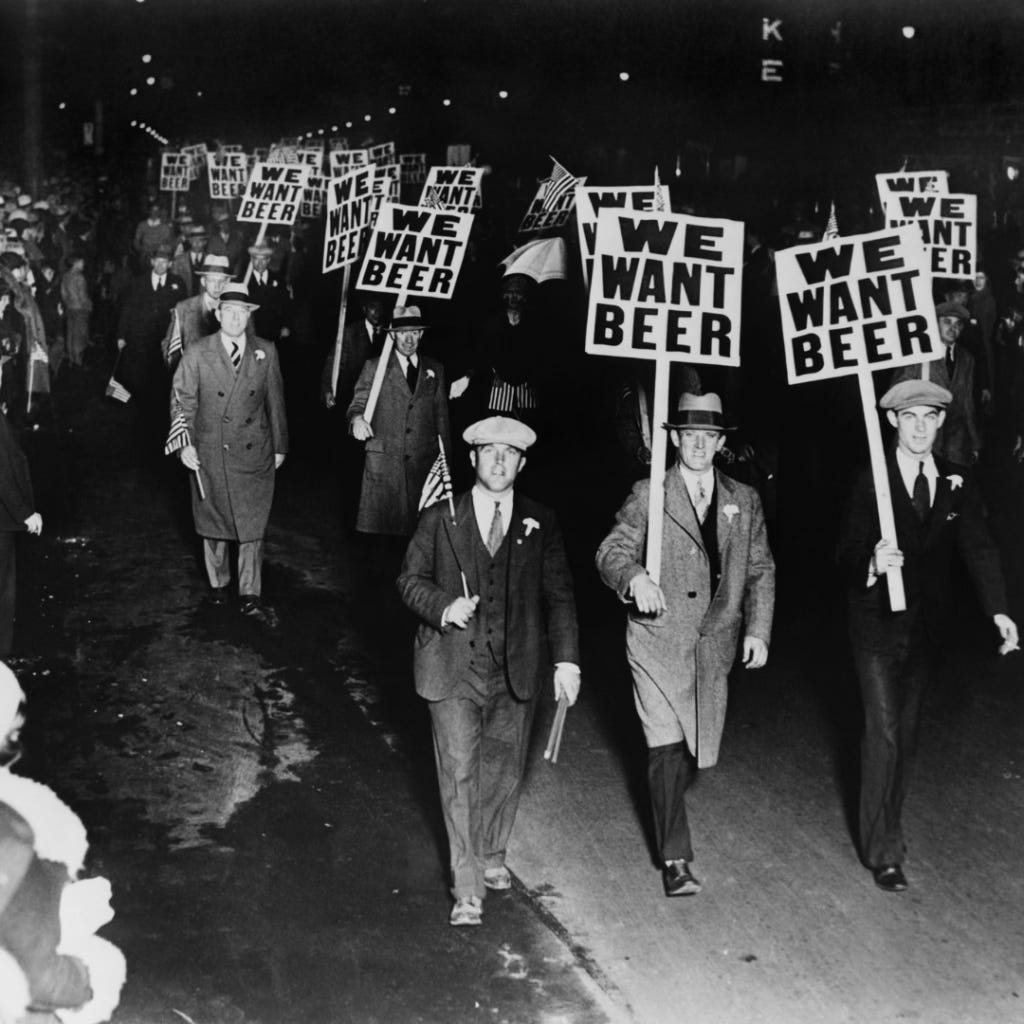
This Day in Legal History: 21st Amendment Ratified
On December 5, 1933, the United States ratified the Twenty-first Amendment to the Constitution, officially ending the era of national Prohibition. This amendment repealed the Eighteenth Amendment, which had banned the manufacture, sale, and transportation of intoxicating liquors since 1920. Prohibition, championed by temperance movements and moral reformers, was initially seen as a solution to social problems such as crime and poverty. However, over the following decade, it led instead to a surge in organized crime, illegal speakeasies, and widespread disregard for the law.
The Twenty-first Amendment is unique in American legal history—it is the only amendment to repeal a previous amendment. It is also the only amendment ratified through state conventions rather than by state legislatures, a strategic move to bypass potential legislative gridlock. Utah became the 36th state to ratify the amendment, securing the three-fourths majority needed for adoption.
The repeal of Prohibition returned control over alcohol regulation to the states, many of which continued restrictions at the local level. The amendment’s passage marked a shift toward a more pragmatic and less moralistic approach to federal lawmaking. It also highlighted the limits of federal power to regulate personal behavior and underscored the complexities of enforcing unpopular laws.
In the broader context of constitutional law, the Twenty-first Amendment demonstrated the capacity of the Constitution to adapt and self-correct. It remains a pivotal example of how constitutional amendments can respond to changing public sentiment and unintended legal consequences.
A federal appeals court allowed President Donald Trump to continue deploying National Guard troops in Washington, D.C., halting a lower court ruling that would have required the troops to withdraw by December 11. The temporary order from the D.C. Circuit Court does not address the underlying legality of the deployment but permits it to proceed while litigation continues. The deployment, which began in August, intensified after a November 26 shooting near the White House left two National Guard members injured—one fatally. Trump responded by sending 500 additional troops and renewing his call to halt immigration from what he called “third-world countries,” after a 29-year-old Afghan national was charged in the attack.
D.C. Attorney General Brian Schwalb sued the administration in September, arguing Trump unlawfully took over local policing authority and violated federal restrictions on military involvement in domestic law enforcement. A federal judge initially sided with Schwalb, calling the deployment likely unlawful, but delayed enforcement of her ruling to allow time for appeal. The Trump administration maintains it can deploy troops to D.C. without local approval, citing the city’s unique federal status. Meanwhile, similar deployments in other Democratic-led cities have sparked lawsuits and accusations that Trump is using federal force for political purposes. Lower courts have largely ruled against these moves, and the Supreme Court is expected to weigh in on the legality of the Chicago deployment soon.
Appeals court allows Trump National Guard deployment in DC to continue | Reuters
Tom Goldstein, a prominent Washington attorney and co-founder of SCOTUSblog, is fighting to sell his $3 million home in D.C.’s Wesley Heights to fund his defense against 22 financial crime charges, including tax evasion. Prosecutors allege that Goldstein, who has made millions as a poker player, misrepresented his financial situation to obtain loans, including one used to purchase the property. A Maryland federal judge barred the sale, ruling the house is likely connected to the alleged crimes. Goldstein has appealed, arguing that blocking the sale violates his Sixth Amendment right to use untainted assets for legal defense, and insists the home is not tied to the alleged misconduct.
The appeal is before the 4th Circuit, where Goldstein—representing himself—says he’s accumulated millions in legal fees. Prosecutors maintain the house is tainted because Goldstein omitted over $15 million in debt from the mortgage application. The home is also collateral for Goldstein’s appearance bond, due to his being labeled a flight risk. One of Goldstein’s key financial backers, litigation funder Parabellum Capital, is a witness in the case but not accused of wrongdoing. Legal experts say his effort to sell the house faces steep odds given the property’s legal entanglements and standard federal practices regarding tainted assets.
Tom Goldstein fights to sell home as tax trial looms | Reuters
A federal grand jury has declined to indict New York Attorney General Letitia James, rejecting prosecutors’ second attempt to bring criminal charges against her, according to sources familiar with the matter. The Justice Department had sought to revive a case involving allegations of bank fraud and false statements related to a mortgage, after the initial indictment was dismissed in November due to the unlawful appointment of the prosecutor, Lindsey Halligan. Despite the setback, prosecutors reportedly plan to seek a new indictment.
James, a Democrat and prominent critic of Donald Trump, was accused of misrepresenting financial information to obtain favorable mortgage terms on a Virginia property. She pleaded not guilty to the original charges. The failed indictment effort comes amid broader DOJ efforts targeting Trump critics, including former FBI Director James Comey and ex-national security adviser John Bolton—cases that have also faced legal hurdles.
Grand jury rejections are rare, as prosecutors usually face a low threshold of probable cause to proceed. James is now the highest-profile figure to have such a case rejected during Trump’s second term. The president has publicly attacked James for leading a civil fraud lawsuit against him, which resulted in a massive financial penalty, later reduced on appeal but with Trump still found liable for fraud.
Lawyers representing authors and publishers in a $1.5 billion copyright settlement with AI company Anthropic have requested $300 million in legal fees, amounting to 20% of the total settlement. Filed in federal court in San Francisco, the fee request comes after Anthropic agreed in October to settle claims it used pirated books to train its AI models, including its commercial product Claude. As part of the agreement, Anthropic will pay over $3,000 per infringed work, destroy the infringing datasets, and certify they are not part of its commercial systems.
The legal team, led by Susman Godfrey and Lieff Cabraser, argued that the fee is “conservative” by class action standards, citing more than 26,000 hours of high-risk work. The settlement, which received preliminary approval in September, is being described as the largest reported copyright class action resolution to date. Anthropic has denied wrongdoing and retains the right to contest the fee amount.
Authors have until January 15 to opt out of the class action and pursue individual claims. A final fairness hearing before U.S. District Judge William Alsup is scheduled for April, where objections from class members and fee disputes will be reviewed.
Authors’ lawyers in $1.5 billion Anthropic settlement seek $300 million | Reuters

This week’s closing theme is by Wolfgang Amadeus Mozart, a composer of some note.
On December 5, 1791, the world lost one of its greatest musical minds: Wolfgang Amadeus Mozart. Just 35 years old at the time of his death, Mozart left behind an astonishing body of work that shaped the course of Western classical music. His death, shrouded in speculation and mystery, came while he was in the midst of composing what would become one of his most profound and haunting works—the Requiem in D minor, K. 626. The Lacrymosa movement, in particular, captures the emotional gravity of that moment, as if echoing his own impending end.
Although Mozart did not live to finish the Requiem, the fragments he left behind were completed by his student Franz Xaver Süssmayr, guided by sketches and oral instruction. The Lacrymosa, with its solemn melodies and aching harmonies, stands as one of the most emotionally resonant sections of the work. Franz Liszt later transcribed it for solo piano, creating a version that retains its choral intensity while adding a layer of intimate, virtuosic expressiveness.
Listening to Liszt’s transcription of the Lacrymosa is like hearing Mozart’s farewell whispered through the keys of a piano—stark, mournful, and deeply human. December 5, then, is not only the date of Mozart’s passing but also a reminder of the enduring beauty he left behind, etched into every phrase of the Requiem. His music, especially in this piece, speaks across centuries to the depths of loss and the hope of transcendence.
Without further ado, Mozart’s Requiem in D. minor – enjoy!


