


This Day in Legal History: Rosa Parks Arrested
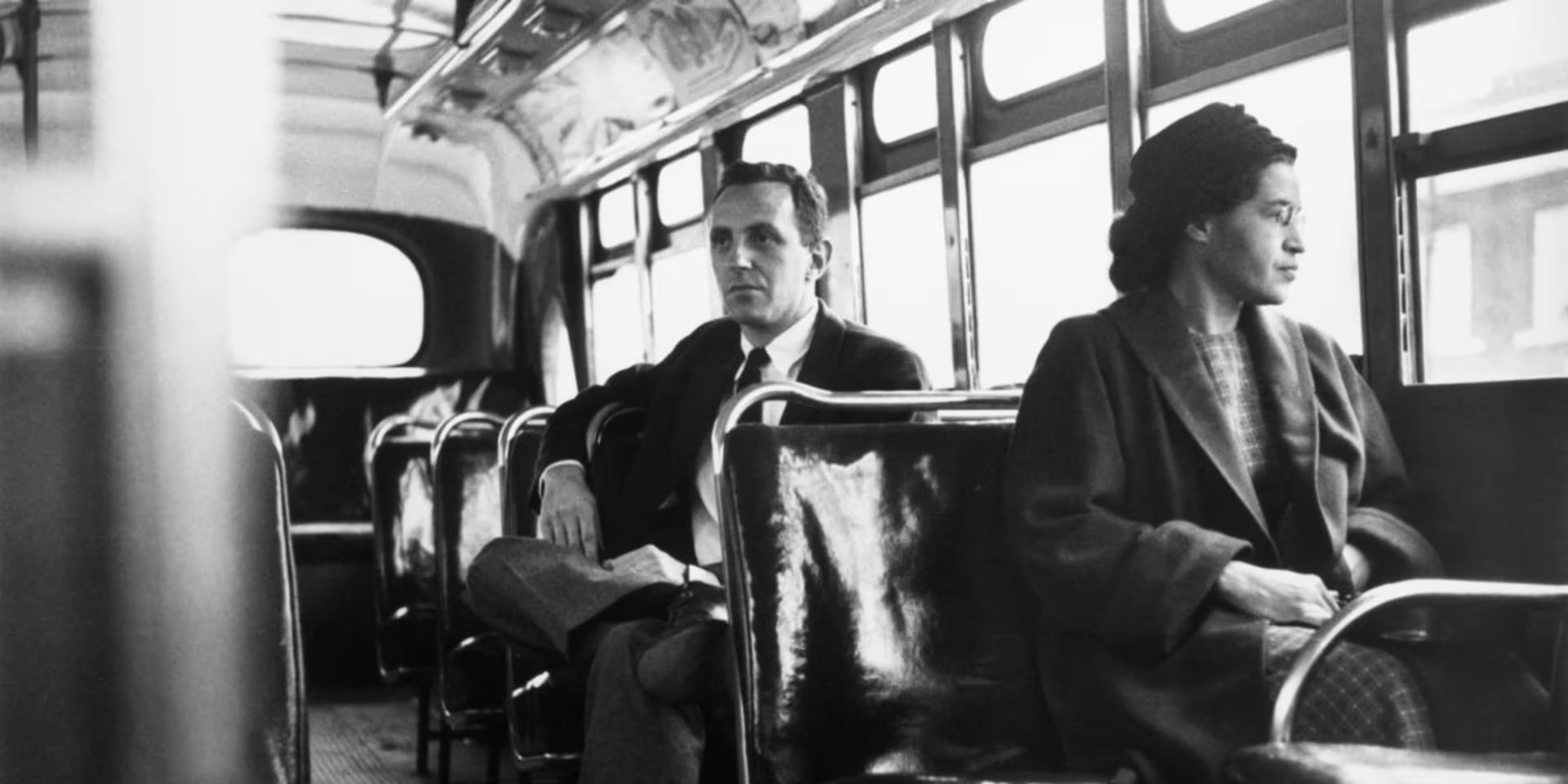
On December 1, 1955, Rosa Parks was arrested in Montgomery, Alabama, for refusing to surrender her seat to a white passenger on a segregated city bus. Parks, a 42-year-old Black seamstress and longtime activist, had been sitting in the “colored” section when the driver demanded she move. Her quiet but firm defiance violated local segregation laws, which mandated racial separation in public transportation and required Black passengers to yield seats to white passengers when buses became crowded. Parks’ arrest became a catalyst for the Montgomery Bus Boycott, a coordinated campaign to end racial segregation on public transit.
The boycott began four days later, organized by the Montgomery Improvement Association, with a then-unknown Martin Luther King Jr. as its president. It lasted over a year, during which thousands of Black residents refused to use the city’s buses, severely impacting the transit system’s finances. The protest was not only a powerful act of collective resistance but also a carefully structured legal challenge. Civil rights attorneys, including Fred Gray, filed a federal lawsuit—Browder v. Gayle—on behalf of several Black women who had experienced bus segregation.
In November 1956, the federal district court ruled that Montgomery’s segregated bus system was unconstitutional under the Equal Protection Clause of the Fourteenth Amendment. The U.S. Supreme Court affirmed the decision, and on December 20, 1956, the boycott officially ended when the Court’s ruling was implemented. Rosa Parks’ arrest and the movement it sparked marked a turning point in the American civil rights struggle. Her individual act of resistance ignited a mass movement and set the stage for future legal and social change.
The U.S. Supreme Court will hear a key copyright case today involving Cox Communications and several major record labels, including Sony, Warner, and Universal. The case centers on whether Cox can be held financially liable for allegedly enabling its users to illegally download music. A jury originally awarded the labels $1 billion in 2019 after finding Cox secondarily liable for over 10,000 copyright infringements, but the 4th Circuit Court of Appeals later reversed part of that decision, leading to a retrial on damages.
Cox argues it shouldn’t be held accountable for users’ actions, warning that a ruling against it could force ISPs to terminate internet access for entire households or public institutions over alleged piracy. The company claims it reasonably handled piracy reports and criticized the notion that it failed to act. In contrast, the labels accuse Cox of ignoring thousands of infringement notices and protecting profitable repeat offenders while readily cutting off nonpaying customers.
Big tech companies like Google, Amazon, and Microsoft have sided with Cox, suggesting that a ruling for the labels could harm the internet economy. Meanwhile, the Trump administration—represented by Solicitor General John Sauer—is supporting Cox’s view that merely knowing about piracy isn’t enough to establish liability. Industry groups in music, film, and publishing back the labels, arguing that Cox’s stance threatens collaborative anti-piracy efforts. The Supreme Court’s decision could reshape how ISPs respond to copyright violations.
US Supreme Court to hear copyright dispute between Cox and record labels | Reuters
Following a deadly shooting in Washington, D.C., involving an Afghan immigrant accused of killing a National Guard member, President Donald Trump has intensified efforts to restrict legal immigration. Within 48 hours of the attack, Trump paused Afghan immigration applications, launched a review of asylum approvals from the Biden era, and hinted at expanded vetting under his existing travel ban targeting 19 countries. These moves revive and build upon restrictive immigration policies from Trump’s first term, now framed as necessary for national security.
Critics argue the administration is exploiting a tragic but isolated incident to justify sweeping immigration rollbacks. Afghan advocacy groups stressed that Afghan immigrants undergo extensive vetting and should not be broadly blamed. While Trump and top officials suggested large-scale reforms—like ending federal benefits for non-citizens and denaturalizing those deemed a threat—federal agencies have so far announced more limited actions, such as case reviews for applicants from travel-ban countries.
Legal experts warn that some of the proposed policies, including denying welfare to lawful residents and mass denaturalization, would likely be ruled unconstitutional. Nonetheless, the administration is signaling an aggressive stance, despite polls showing declining public approval of Trump’s immigration policies. Meanwhile, Democrats accuse Trump of targeting law-abiding immigrants and using fear-based tactics for political gain.
Trump sharpens focus on legal immigration after National Guard shooting | Reuters
A federal judge’s decision to ban generative AI from his chambers after an intern used it in a flawed court opinion has sparked debate over how technology should be used in the legal system. Judge Julien Neals of New Jersey attributed the error in a June ruling to a law student who used AI in violation of their school’s policy, prompting Neals to prohibit AI use entirely among his staff. His response to Senator Chuck Grassley drew concern from legal academics and judges who argue that banning AI outright may be shortsighted.
Proponents of AI in the judiciary say the technology, if used responsibly, could reduce case backlogs and improve efficiency amid staffing shortages. Judge Xavier Rodriguez of Texas ran an experiment comparing traditional opinion writing with AI-assisted drafting, showing significant time savings without sacrificing quality. He and others advocate for structured AI use, emphasizing vetting, fact-checking, and clear protocols to preserve judicial integrity.
Magistrate Judge Allison Goddard and law professors like David Kemp suggest that instead of bans, institutions should focus on teaching students ethical and effective AI use. With many law students already accustomed to using generative AI, schools are scrambling to develop policies and training. Some institutions, like the University of Chicago Law School, have embraced AI integration, while others lag behind. The incident in Judge Neals’ courtroom has become a wake-up call for courts and law schools to align on responsible AI use in legal education and practice.
Judges’ AI Blunders Spark Debate on Technology Use in Courts
Luigi Mangione, accused of killing UnitedHealthcare CEO Brian Thompson in a high-profile shooting outside a Manhattan hotel, appeared in court today for key pretrial hearings. The 27-year-old, arrested in December 2024, has pleaded not guilty to murder and multiple related charges in both state and federal cases. The hearings will determine whether crucial evidence—including a 3-D printed gun, silencer, and journal writings found in Mangione’s backpack—can be used at trial. His defense argues that the items were obtained through an illegal search during his arrest in Pennsylvania and that statements he made to police should also be excluded.
Prosecutors dispute those claims and are seeking to admit the materials, which they argue implicate Mangione in the killing. Mangione, who has gained a controversial following among critics of the U.S. healthcare system, faces life in prison if convicted of second-degree murder. In a separate federal case, prosecutors intend to seek the death penalty. Earlier in September, two terrorism charges were dismissed after a judge ruled there was insufficient evidence Mangione intended to intimidate healthcare workers or influence government policy.
The hearings, overseen by Judge Gregory Carro, are expected to last through the week and include testimony from arresting officers. No trial date has yet been set, and Mangione remains in federal custody in Brooklyn.
Luigi Mangione due in court for pretrial hearings over US healthcare executive’s killing | Reuters


