


This Day in Legal History: Federal Court Strikes Down “Balanced Treatment” Law in Arkansas
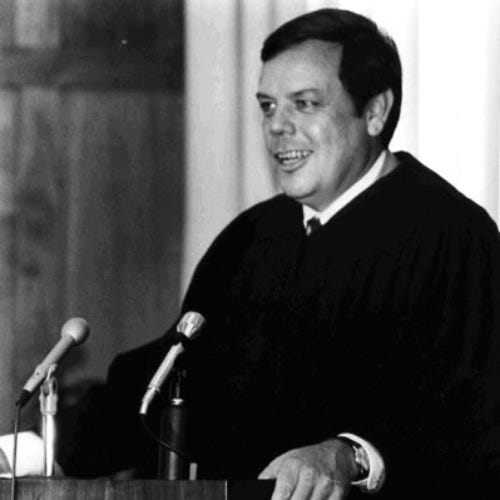
On January 5, 1982, a federal district court in Arkansas issued a landmark ruling in McLean v. Arkansas Board of Education, striking down a state law that required public schools to give “balanced treatment” to both evolution and creation science. The law, known as Act 590, had been passed in 1981 and mandated that schools teach creationism—defined in the statute as a scientific model based on a literal interpretation of the Bible—alongside evolution. The law was immediately challenged by a coalition of clergy, educators, and scientists who argued that it violated the Establishment Clause of the First Amendment.
Judge William Overton ruled that Act 590 was unconstitutional because it advanced a particular religious viewpoint under the guise of science. In his decision, Overton provided a clear and influential definition of what constitutes science, stating that scientific theories must be guided by natural law, testable, and subject to falsification. He found that “creation science” failed all of these criteria and was therefore religious in nature, not scientific. The court also concluded that requiring its teaching in public schools constituted state endorsement of religion.
The ruling marked one of the first major judicial rejections of efforts to include religious doctrine in public school science curricula following the U.S. Supreme Court’s earlier decision in Epperson v. Arkansas (1968), which struck down laws banning the teaching of evolution altogether. McLean v. Arkansas would go on to shape the legal and educational landscape in future church-state separation cases, including the pivotal 1987 Supreme Court decision Edwards v. Aguillard, which similarly invalidated a Louisiana law promoting creationism in schools.
Venezuelan leader Nicolás Maduro appeared in a New York court after a surprise U.S. military operation captured him in Caracas. The high-stakes raid, likened to the 1989 Panama invasion, involved U.S. Special Forces breaching Maduro’s security and flying him to Manhattan, where he faces drug trafficking and narco-terrorism charges. His wife, Cilia Flores, was also captured. Maduro is accused of running a cocaine network in collaboration with major criminal groups like Mexico’s Sinaloa cartel and Colombia’s FARC.
The capture sparked international outrage. Russia, China, Cuba, and other allies condemned the raid, while U.S. allies cautiously emphasized legality and diplomacy. The U.N. Security Council is set to review the operation’s legality. Meanwhile, Venezuela’s acting president, Delcy Rodríguez, shifted from initial outrage to signaling willingness for cooperation with the U.S., a notable pivot considering her past as a fiery Chavista loyalist.
President Trump justified the move as a counter to drug smuggling, illegal immigration, and the past nationalization of U.S. oil assets. He also made clear his aim to reopen Venezuela’s oil sector to U.S. companies. However, he has sidelined Venezuela’s opposition leaders, disappointing figures like María Corina Machado. Despite Maduro’s removal, his political allies remain in power, and the military’s loyalty appears unchanged. Venezuelans at home are wary, bracing for possible unrest.
Venezuela’s Maduro due in court, loyalists send message to Trump | Reuters
Trump’s efforts to further reshape the federal judiciary in 2026 are facing a slowdown due to a shortage of vacancies. After returning to office in 2025, Trump secured the confirmation of 26 judicial nominees—more than in the first year of his initial term. However, only 30 new judicial seats have opened since then, compared to the 108 vacancies available when he first took office in 2017. This is largely due to aggressive judicial appointments by both Trump and former President Biden over the past decade, which filled many potential retirements with younger judges.
Some judges eligible for senior status—a form of semi-retirement—have opted to remain active. Experts suggest this could be due to either personal preference or distrust among conservative judges about Trump’s choices for replacements. The appellate court nominations have particularly slowed, with only three judges announcing retirements in 2025. Still, Trump managed to flip the balance of the 3rd Circuit Court of Appeals and strengthen conservative influence in district courts across states like Missouri, Florida, and Mississippi.
Despite the low number of available seats—currently 49—Trump still has opportunities to make appointments, especially in Republican-led states. However, 13 of those vacancies are in states with at least one Democratic senator, triggering the “blue slip” custom, which allows senators to block judicial nominees from their states. While this tradition doesn’t apply to appellate courts, it still limits district court nominations. Senate Republicans remain divided on whether to uphold the blue slip norm.
Trump’s ability to further reshape judiciary in 2026 hindered by few vacancies | Reuters
In 2026, U.S. law schools are facing a mix of rising interest in legal education and mounting regulatory and financial pressures. A major shift comes from President Trump’s 2025 budget, which capped federal loans for professional degrees at $50,000 annually and $200,000 total. With many law schools charging over $50,000 per year (excluding living costs), incoming students may need to seek private loans, which often come with higher interest rates and stricter credit requirements. In response, some schools—like Santa Clara University—are offering across-the-board scholarships to help bridge the gap.
Law school accreditation is also in flux. The American Bar Association (ABA), traditionally the primary accreditor, is facing political attacks over its diversity standards and regulatory burden. Texas is planning to develop its own law school approval system for bar eligibility, and other states like Florida and Ohio are exploring similar options. The ABA is now working to streamline its standards amid this pressure.
July 2026 will also see the debut of the “NextGen UBE,” a shorter, skills-focused national bar exam that replaces some memorization with practical assessment. Some states, however, are opting out or creating their own licensing alternatives.
Meanwhile, artificial intelligence is gaining traction in legal education. A growing number of law schools are integrating AI training into their curricula, and platforms like Harvey are being adopted by faculty and students alike.
Despite the looming challenges, interest in law school remains strong. Applicant numbers rose 20% over the previous year, building on an 18% increase in 2024, and first-year enrollment is also trending upward.
US law schools face loan limits, oversight pressures in 2026 | Reuters
U.S. courts are poised to play a decisive role in shaping how copyright law applies to generative AI this year, as lawsuits from major publishers, creators, and tech companies come to a head. At issue is whether AI developers like OpenAI, Google, Meta, and others can invoke the legal doctrine of fair use when training models on copyrighted materials, or whether they must pay license fees—potentially amounting to billions.
The legal landscape shifted dramatically in 2025. A class action by authors against Anthropic resulted in a $1.5 billion settlement, the largest of its kind, while The New York Times, Disney, and other major rights holders filed fresh lawsuits. Judges began issuing preliminary rulings on whether AI training qualifies as transformative fair use, with conflicting outcomes. One judge called AI training “quintessentially transformative,” supporting tech companies’ claims, while another warned that generative AI could harm creators by saturating the market with competing content.
Several high-profile cases remain active in 2026, including those involving AI-generated music and visual art. Meanwhile, some copyright holders are choosing collaboration over litigation. Disney, for example, invested $1 billion in OpenAI and granted use of its characters, while Warner Music dropped lawsuits against AI firms to co-develop music tools. These deals hint at possible industry-wide licensing frameworks, though ongoing litigation could still dramatically reshape the economic and legal norms governing AI.
AI copyright battles enter pivotal year as US courts weigh fair use | Reuters


