


This Day in Legal History: George Washington Delivers First State of the Union Address
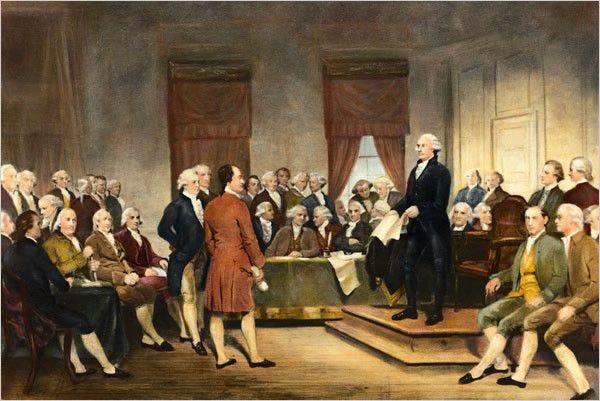
On January 8, 1790, President George Washington delivered the first State of the Union address to a joint session of the U.S. Congress in New York City, the temporary capital of the United States. This moment marked the formal inauguration of a constitutional duty outlined in Article II, Section 3, which requires the president to periodically give Congress information on the “State of the Union.” Washington’s address was brief—just over 1,000 words—but carried significant weight, as it was the first time a sitting president had spoken to the legislature under the newly ratified Constitution.
In his remarks, Washington emphasized the need to build public credit, maintain national defense, and promote science and literature. He called on Congress to consider a system of uniform weights and measures and to establish a national post office. Notably, he stressed the importance of establishing laws that would encourage “a due respect for property” and “the security of liberty.” His recommendations helped shape the early legislative agenda and solidify the constitutional structure of government roles.
The address was delivered in person, following British parliamentary tradition, but Thomas Jefferson would later abandon this practice in favor of written messages, considering in-person speeches too monarchical in tone. Washington’s speech helped define the president’s role not merely as an executive but as a constitutional communicator, responsible for setting national priorities in collaboration with Congress.
The legal legacy of this event lies in the precedent it established: that the president would serve not only as head of state and government, but also as an active participant in shaping legislative goals through regular, formal communication. Over time, this annual message evolved into a major political and legal event, shaping policy narratives and underscoring the balance of powers between the branches of government.
Tysen Duva, a long-serving federal prosecutor from Florida, was recently sworn in as head of the U.S. Justice Department’s Criminal Division, a powerful role now seen as vulnerable to political pressure under President Trump’s second term. Duva replaces acting chief Matthew Galeotti, who, despite not being a permanent appointee, had earned respect for shielding the division from direct political interference and maintaining operational independence, particularly in white-collar and public corruption cases. Duva, who has no prior managerial experience at this scale, will now oversee over 1,000 prosecutors amid ongoing departmental turmoil, internal resignations, and controversial Trump-driven interventions.
His appointment follows internal conflict, including a recent case where Duva clashed with a Trump-aligned U.S. attorney who tried to fast-track charges against a Democratic congresswoman. While the charges ultimately proceeded, the case highlights the complex political dynamics Duva must now navigate. Though Duva has pledged impartiality and praised Galeotti’s example, his lack of a close working relationship with Deputy AG Todd Blanche—unlike Galeotti—may limit his autonomy.
Observers note that the Criminal Division has largely avoided the most contentious political directives of the Trump administration so far, including investigations into Trump’s critics and cultural flashpoints like gender-affirming care. However, experts warn that Duva may face tighter constraints going forward, with limits placed on certain enforcement areas like overseas bribery and tariff violations. DOJ veterans emphasize that how Duva manages pressure from Attorney General Pam Bondi, Blanche, and the White House will determine the future direction of the department’s criminal enforcement strategy.
Political Tension Awaits DOJ’s Unproven Criminal Division Chief
The UK’s Information Commissioner’s Office (ICO) has contacted Elon Musk’s platform X and his AI company xAI, seeking clarification on how they are complying with UK data protection laws. The inquiry follows reports raising concerns about Grok, X’s built-in AI chatbot, and its ability to generate images that may involve the use of personal data. The ICO emphasized that individuals have the right to expect lawful and respectful handling of their personal information on social media platforms. The regulator is requesting details on the safeguards X and xAI have in place to protect user privacy and uphold legal standards under UK data law.
Reports have intensified regulatory concern by alleging that Grok has generated explicit images involving underage individuals. The claims raise serious legal and ethical questions under UK data protection and child‑safety laws. Such allegations heighten scrutiny of how training data is sourced, what safeguards are in place to prevent harmful outputs, and how quickly platforms respond when prohibited content is identified. The ICO’s outreach suggests regulators are assessing whether existing controls are adequate to prevent the creation or dissemination (clearly not) of unlawful material and to protect minors’ rights.
UK data watchdog contacts Musk’s X over Grok AI images | Reuters
Ford Motor Company has refiled a lawsuit accusing three California attorneys of orchestrating a fraudulent overbilling scheme to collect more than $100 million in legal fees under the state’s Lemon Law. The amended complaint, allowed after a judge dismissed the original case in November, drops law firms as defendants and instead targets individual lawyers Steve Mikhov, Roger Kirnos, and Amy Morse, formerly of Knight Law Group. Ford alleges the attorneys operated a “Fee Motion Department” that submitted fake time entries, including implausible claims such as multiple 24-hour workdays and even a single day billed at 57.5 hours.
The lawsuit claims these practices defrauded courts and automakers by inflating legal fees in warranty cases involving defective vehicles. California’s Lemon Law allows recovery of attorney fees for reasonable legal work, but Ford argues the defendants manipulated this provision for profit. Ford’s legal team says the amended filing includes new details drawn from testimony, reinforcing their claim that the lawyers exploited the court system. The accused attorneys have denied wrongdoing and previously argued the case is a retaliatory move by Ford meant to intimidate lawyers representing consumers. The case continues in the U.S. District Court for the Central District of California.
Ford takes fresh aim at lawyers in lawsuit claiming overbilling scheme | Reuters


