


This Day in Legal History: Wallace Stands in the Schoolhouse Door
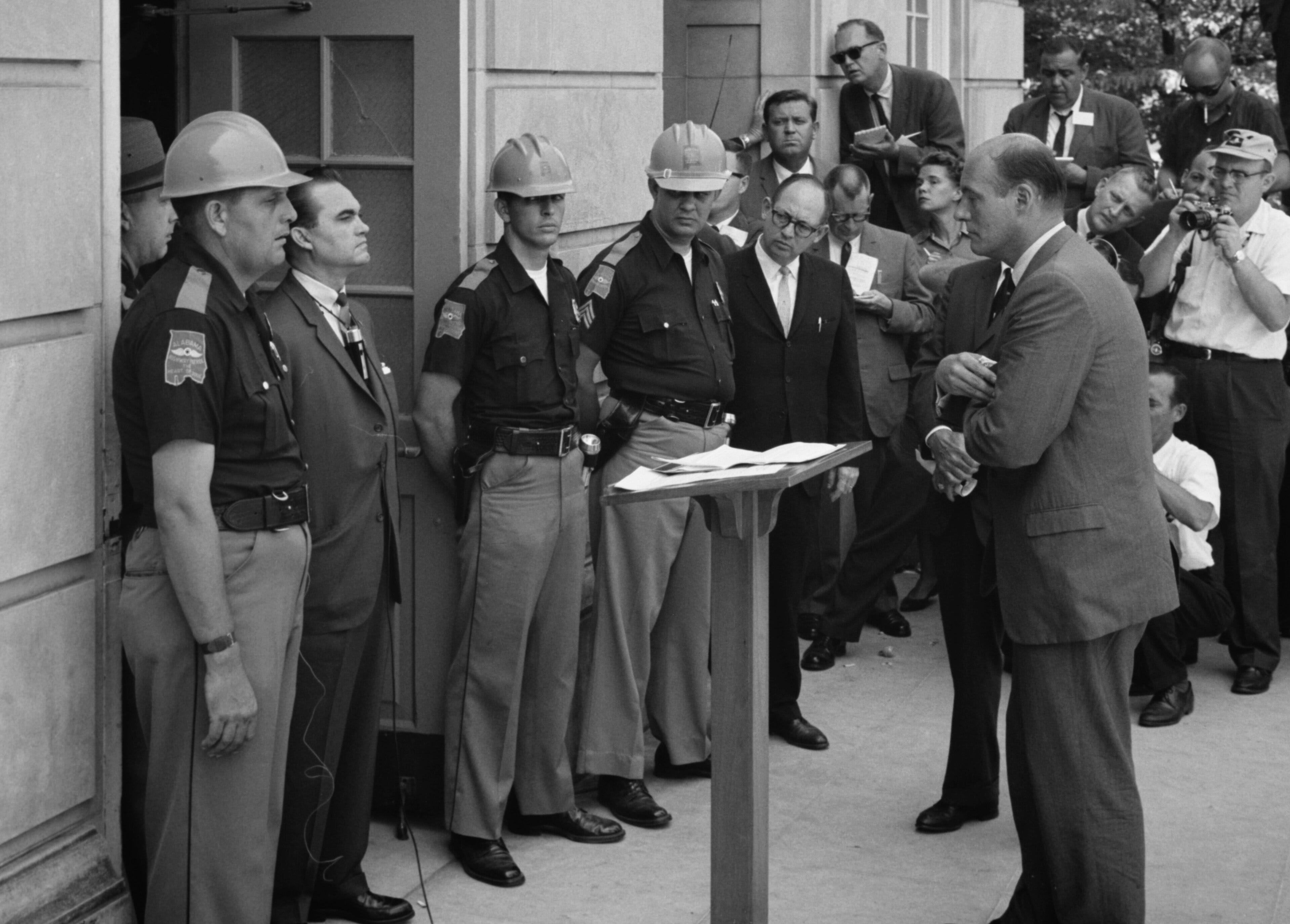
On this day in 1963, Alabama Governor George Wallace physically stood in the doorway of Foster Auditorium at the University of Alabama to block the registration of Vivian Malone and James Hood, the two Black students whose enrollment had been ordered by a federal district court. Wallace’s “Stand in the Schoolhouse Door” was the culmination of a long campaign of state defiance of federal desegregation orders that ran from Brown v. Board in 1954 through Cooper v. Aaron in 1958 — the case in which a unanimous Supreme Court told the Little Rock school district, and by extension every state actor, that federal constitutional rulings are the supreme law of the land and that state officials may not nullify them.
President Kennedy responded to Wallace’s stand by issuing Executive Order 11111, which federalized the Alabama National Guard, and ordering Deputy Attorney General Nicholas Katzenbach down to Tuscaloosa to confront the governor. Wallace gave a long speech invoking states’ rights and Tenth Amendment sovereignty, then stepped aside, and Malone and Hood walked in and registered. That night, Kennedy went on national television and delivered the civil rights address that put the Civil Rights Act of 1964 onto the national agenda. The legal and political throughline matters: the schoolhouse door, the executive order federalizing the Guard, the televised address, and the omnibus civil rights legislation that followed were a single coordinated federal response to massive resistance, and the institutional habit they built — the willingness of the federal political branches to back federal court orders with whatever force is necessary — is the substrate on which the modern enforcement of civil rights law sits. Whether that habit holds up under contemporary pressure is one of the live constitutional questions of our moment.
The “Anti-Weaponization Fund” saga we have been following all week reached at least a partial resolution on Wednesday when Judge Leonie Brinkema of the Eastern District of Virginia declined to extend her temporary restraining order against the program into a preliminary injunction. The reason, in essence, is that the Justice Department has now formally represented to the court, in writing and through acting Attorney General Todd Blanche, that the $1.8 billion fund is “not going forward.” Brinkema took DOJ at its word for present purposes and dissolved the TRO, which under standard mootness doctrine is the right call when a defendant credibly commits to abandoning the challenged program. But she also did something practical: she warned the government in plain terms not to “play possum with this court,” language that gives the plaintiffs a built-in mechanism to come back fast if the fund quietly re-emerges under a different name.
The substantive theory the plaintiffs were pressing — that the fund is an unappropriated expenditure of public money, that the underlying Trump-IRS settlement was a litigation in which the United States was never really adverse to the President in his personal capacity, and that the program’s payout criteria are based on political characterizations of past prosecutions rather than any neutral standard — is now preserved for another day rather than litigated to judgment. The practical lesson is the durability of voluntary-cessation doctrine: a government defendant who is willing to abandon a program in court usually wins on mootness, but the cost is real, because future revivals get scrutinized against the prior representation. Watch the Federal Register and the DOJ component-level budget submissions for the next six months — if there is a successor program coming, those are where the first signal appears.
A coalition of environmental and tribal-nation plaintiffs filed suit in the U.S. District Court for the District of Columbia on Wednesday seeking to block a U.S. Fish and Wildlife Service-approved land exchange that would transfer 715 acres of the Lower Rio Grande Valley National Wildlife Refuge to SpaceX, in return for 683 acres of privately owned land elsewhere. The plaintiffs are the Center for Biological Diversity, Save RGV, the Carrizo/Comecrudo Nation of Texas, and the South Texas Environmental Justice Network.
The legal theory of the case is unusually multi-statute: the complaint alleges violations of the National Wildlife Refuge System Improvement Act of 1997, the National Historic Preservation Act, the National Environmental Policy Act, and the Administrative Procedure Act, with the central administrative-law argument being that the Fish and Wildlife Service’s environmental analysis failed to grapple seriously with impacts on endangered ocelots, aplomado falcons, and a long list of migratory species whose habitat the refuge was designed to protect when Congress created it in 1979. The plaintiffs describe this as one of the largest national-wildlife-refuge land exchanges outside Alaska, and the suit asks for vacatur of the exchange decision rather than damages — the standard APA remedy.
The political and infrastructural backdrop is hard to miss: SpaceX’s Starbase facility at Boca Chica has been expanding into the Lower Rio Grande Valley for years now, and the exchange would consolidate the company’s footprint on land previously held for the protection of one of the last remaining ocelot ranges in the country. The merits of the case will turn on the rigor of the FWS environmental analysis. Expect a request for a preliminary injunction within weeks.
Lawsuit challenges Trump administration’s land swap with SpaceX in Texas | The Washington Post
A Los Angeles County jury on Wednesday added $22 million in punitive damages to the $176 million compensatory verdict already entered against socialite and former philanthropist Rebecca Grossman and former Major League Baseball pitcher Scott Erickson, bringing the total civil award to the Iskander family to roughly $198 million.
The underlying facts of the case are stark: in September 2020, Grossman and Erickson left a Westlake Village restaurant after drinking and street-raced separate Mercedes SUVs through a residential neighborhood, with Grossman striking and killing two young brothers, Mark and Jacob Iskander, then 11 and 8, as they crossed a marked crosswalk with their parents.
Grossman was convicted of two counts of murder in 2024 and is serving 15 years to life. The civil case the family brought is the wrongful-death companion, and the punitive damages award the jury added on Wednesday is the part that does the most policy work: the jury split the punitive award $21 million against Grossman, $1.17 million against Erickson, which under California’s reprehensibility-and-net-worth framework reflects both the much greater direct culpability of Grossman as the driver and the substantial disparity in their respective financial positions.
The case is notable beyond the parties involved because of how clean it is on the standard punitive-damages analysis the Supreme Court laid out in BMW v. Gore and State Farm v. Campbell: high reprehensibility, a relatively modest single-digit ratio of punitive-to-compensatory damages, and an underlying compensatory award that itself was supported by the gravity of the loss. Watch for an appeal that focuses on the compensatory rather than the punitive number — that is where the appellate leverage actually is.
Jury Ups Philanthropist, Ex-Pitcher Crash Verdict To $198M | Law360


