



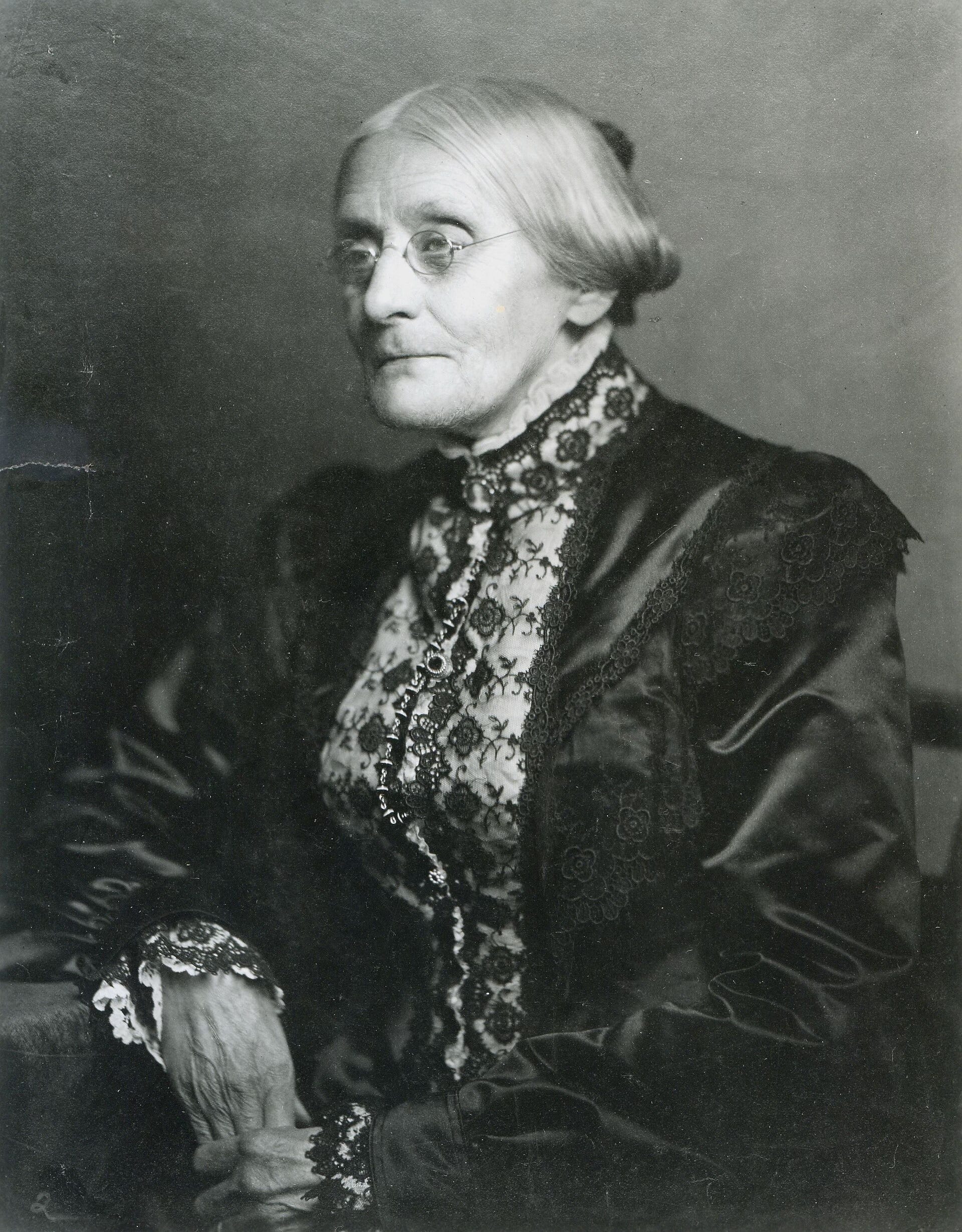
This Day in Legal History: Susan B. Anthony Fined for Voting
On this day in 1873, in a federal courtroom in Canandaigua, New York, Judge Ward Hunt fined Susan B. Anthony one hundred dollars for the crime of voting. Anthony had walked into a polling place in Rochester on November 5, 1872, and cast a ballot for Ulysses S. Grant. She was arrested two weeks later under a federal statute, the Enforcement Act of 1870, that made it a crime to “knowingly” vote without being legally entitled to. Her defense was straightforward: the Fourteenth Amendment, ratified four years earlier, said that all persons born in the United States were citizens, and citizenship carried with it the right to vote. Judge Hunt did not let the jury decide. He directed a verdict of guilty without even letting them deliberate — something that would be plainly unconstitutional today — and then asked Anthony if she had anything to say before sentence was passed.
She did.
She told the court that it had trampled on her natural rights, her civil rights, her political rights, and her judicial rights, and that under such circumstances she would never pay a dollar of the unjust penalty.
She never did.
Hunt declined to jail her for nonpayment, which would have given her the path to appeal she wanted, and the case died without ever reaching the Supreme Court. The Nineteenth Amendment, which finally guaranteed women the right to vote, was ratified forty-seven years later, in 1920 — fourteen years after Anthony’s death. The lesson lawyers usually take from the case is procedural — about directed verdicts, about appellate review, about the ways a determined trial judge can keep a constitutional question off the docket. The lesson worth keeping today is broader. The legal system that one generation treats as obvious common sense is the one a later generation looks back on and cannot understand how anyone thought was just. Anthony lost in court and won in history. That happens more often than the daily case law makes it look.
A federal judge in Michigan ruled Wednesday against Polymarket, a platform that lets people place bets on the outcomes of sports games. Here’s what happened: Polymarket had tried to convince Michigan’s regulators that what it does is not really gambling — it’s a sophisticated financial product called a “swap,” something only the federal government regulates. Polymarket’s argument was: we’re not a sportsbook, we’re a financial market, just like commodity futures markets. A wheat farmer, for example, might use that kind of contract to lock in a price for next year’s harvest. Michigan’s gaming regulators weren’t buying it. They said Polymarket looked and acted like an illegal sportsbook — people betting on sports without a license — and shut it down. Polymarket went to federal court asking the judge to block Michigan from enforcing the law while the lawsuit continues. The judge said no.
He found that Polymarket’s argument didn’t make sense; if something is a bet on a football game, calling it something else doesn’t change what it is. The judge also said that even if Polymarket lost the Michigan market, that’s a business loss that money can compensate — not the kind of serious, immediate harm that would justify stopping Michigan from enforcing its own gambling laws. This case matters because it will help determine how the federal government and individual states regulate online prediction markets going forward. Right now, companies like Polymarket are in legal limbo, unable to operate in states that say they’re gambling, while arguing they should operate under federal financial rules. The courts need to settle which it is.
Mich. Judge Opens Door For Prediction Market Enforcement
An Illinois federal judge ruled Wednesday that a class action lawsuit can proceed against an advertising-technology company that allegedly snuck Americans’ personal information to PDD Holdings, the Chinese parent company of the discount-shopping app Temu. Think of it this way: when you visit websites or use apps, tracking code collects information about you — what you click on, what you buy, where you’re located. That’s normal ad-tech business. But this company allegedly took that data and secretly sent it to China for the Chinese parent company’s benefit. The lawsuit uses two legal theories. First: the federal wiretap law makes it illegal to secretly intercept someone’s communications or data without permission — and the plaintiffs argue this is exactly what happened.
The company embedded invisible code on websites that grabbed user data without asking. Second: there’s a new government regulation that forbids sending Americans’ sensitive personal data to countries the U.S. government considers hostile. China is on that list. The company argued the lawsuit should be dismissed, claiming what it does is standard advertising practice and not really interception. The judge disagreed. He said the lawsuit makes plausible claims of wrongdoing and can proceed. Why this matters: this is one of the first big tests of whether tech companies can keep hiding data-sharing practices in fine-print privacy policies. The judge is signaling that burying consent in a privacy policy probably isn’t enough if you’re secretly sending data to foreign adversaries. The case will now move to discovery — where lawyers dig through company records — and that’s usually expensive enough to push companies toward settlement.
Ad Seller Can’t Shake Wiretap Suit Over Temu Data Transfers
A class action lawsuit filed Wednesday accuses Hilton Grand Vacations — the timeshare and vacation club subsidiary of Hilton Hotels — of repeatedly calling consumers who had registered their phone numbers on the federal Do Not Call list. This is a straightforward violation of federal law. The Do Not Call list is the registry that exists specifically so people can stop getting telemarketing calls. If your number is on that list, companies can’t call you to pitch products unless you’ve done business with them recently or given them permission. Hilton allegedly ignored that. According to the complaint, the company and its marketing contractors called people repeatedly, sometimes years after their numbers were registered on the Do Not Call list, pitching timeshare vacation packages. Here’s why the damages can be huge: the federal law lets you sue for $500 per violation — per call. If a company makes a mistake and thinks the violation was intentional, the damages triple to $1,500 per call. In a class action involving thousands of unwanted calls, those numbers balloon fast. Hilton and other timeshare companies have historically tried to escape liability by claiming their contractors made the calls, not Hilton itself. But courts increasingly reject that defense. If Hilton controlled the marketing campaign and the contractors worked on Hilton’s behalf, Hilton is responsible. The law here is actually simpler than most litigation: a company’s obligation is clear, and the violation is easy to prove if calls were made to numbers on the federal Do Not Call list.


