


This Day in Legal History: The End of Roosevelt’s Hundred Days
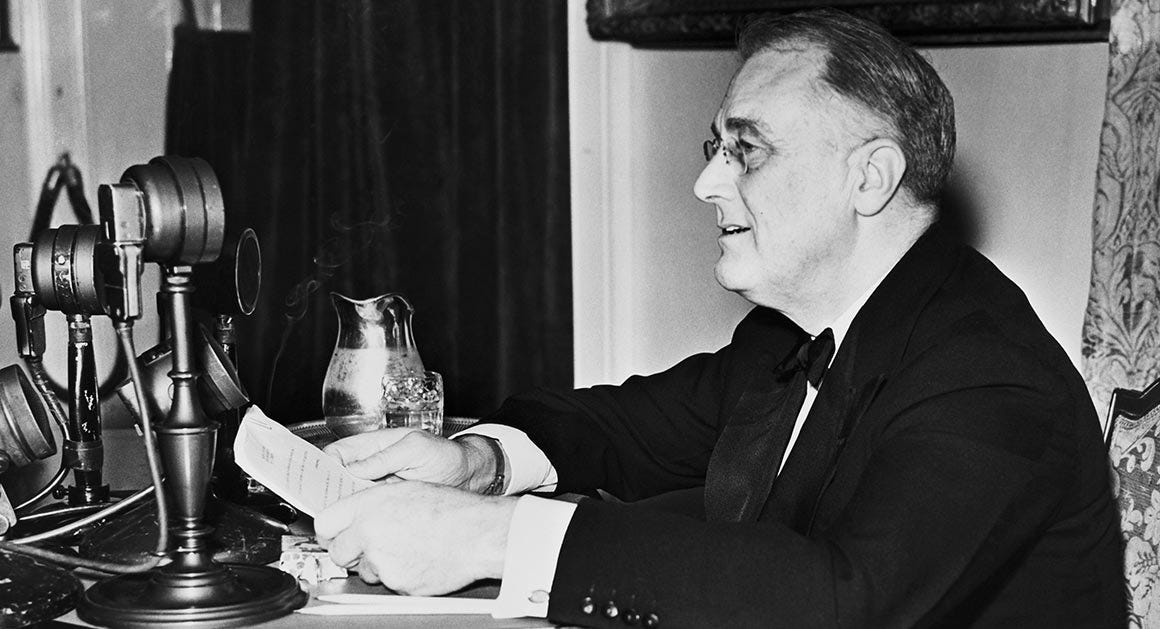
On this day in 1933, Franklin Roosevelt signed three pieces of legislation that closed out what the country has been calling the Hundred Days ever since: the Banking Act of 1933, the National Industrial Recovery Act, and the Farm Credit Act, with the Home Owners’ Loan Act having been signed three days earlier. The Banking Act of 1933 is the one most lawyers know, because the popular name attached to it — Glass-Steagall — has been doing rhetorical work in financial-regulation debates for ninety-three years.
Carter Glass of Virginia and Henry Steagall of Alabama, the Senate Banking chair and the House Banking chair respectively, built the statute around two structural propositions: that commercial banks should be separated from investment banking and the speculative securities business that had helped pull the country into the Great Depression, and that depositors at member banks should be protected by a federal deposit insurance scheme so that a panic at one bank did not become a panic everywhere.
The deposit insurance piece became the Federal Deposit Insurance Corporation. The separation piece was the part that got partially repealed by the Gramm-Leach-Bliley Act in 1999 and then revisited in the aftermath of the 2008 financial crisis. The National Industrial Recovery Act, signed the same day, set up the National Recovery Administration and the Public Works Administration and was meant to coordinate industry-wide codes of fair competition; the Supreme Court struck the centerpiece codes provision down two years later in A.L.A. Schechter Poultry Corp. v. United States in 1935 on nondelegation and Commerce Clause grounds, an opinion that nearly killed the early New Deal and prompted Roosevelt’s court-packing plan two years after that. The Farm Credit Act consolidated and refinanced the agricultural lending system that the Great Depression had taken to the brink.
The legal point worth remembering is that this last day of the Hundred Days was, in retrospect, the moment the federal regulatory state of the twentieth century stopped being a collection of post-Civil-War commissions and started being the integrated structure of agencies, deposit-insurance funds, securities oversight, labor regulation, and welfare administration that the country has lived inside ever since. The fact that the Schechter Court was waiting in the wings to strike down the most ambitious piece of that day’s work is part of the lesson. The constitutional question of how much economic ordering a Congress and a President can do at once was not answered on June 16, 1933 — it was framed.
The Supreme Court on Monday declined to take up E.D. v. Noblesville School District, a free-speech challenge brought by the parents of an Indiana high-school student whose school district had refused to let her post flyers for her student-run anti-abortion club on classroom and hallway walls. The student, identified in court papers by initials because she was a minor when the case was filed, had been the founder of Noblesville High School’s Students for Life chapter. The flyers she wanted posted featured images of demonstrators holding “Defund Planned Parenthood” signs. Noblesville Schools removed the flyers under a district policy giving administrators content-based authority over student materials displayed on school property, and the parents sued under the First Amendment.
The Southern District of Indiana sided with the district in 2024, and the Seventh Circuit affirmed in 2025, both applying Hazelwood School District v. Kuhlmeier, the 1988 case that lets public schools regulate the content of school-sponsored expressive activities if the regulation is reasonably related to legitimate pedagogical concerns. The cert denial leaves Hazelwood intact in the Seventh Circuit and everywhere else.
The piece worth flagging is Justice Alito’s dissent from denial, joined by Justice Thomas, which urged the Court to grant review and use the case to revisit Hazelwood’s framework. The dissent argues that Hazelwood was wrongly decided to the extent that it lets schools draw viewpoint-based lines under the cover of pedagogical-concern review, and that the doctrinal distinction Hazelwood draws between school-sponsored speech and Tinker-style independent student speech has become unworkable in the age of student clubs, distributed school messaging, and post-Mahanoy off-campus speech. Two votes are not five votes. But two votes naming a case as the vehicle they wanted are how the next decade of student-speech cases gets queued up. The Court has now told litigants what kind of vehicle it might be looking for. Expect a steady drumbeat of cert petitions teeing up the Hazelwood revisit over the next several terms.
The Supreme Court also turned away on Monday the National Shooting Sports Foundation’s challenge to New York’s General Business Law § 898, the public-nuisance statute the New York legislature passed in 2021 to let the state and certain private plaintiffs sue firearms manufacturers, distributors, and dealers for endangering the public through the marketing and distribution of their products.
The challenge was supported by Smith & Wesson, Sturm, Ruger, Beretta, Glock, and Sig Sauer, and went up on appeal from a 2024 Second Circuit decision that held the New York statute is not preempted by the Protection of Lawful Commerce in Arms Act, the 2005 federal statute that broadly immunizes the gun industry from civil liability arising from the criminal misuse of firearms.
The Second Circuit reasoned that the PLCAA’s “predicate exception” — which preserves state-law claims when the firearms industry has violated a state or federal statute applicable to the sale or marketing of firearms — covers a state public-nuisance statute that, by its terms, regulates the sale and marketing of firearms. The cert denial leaves the Second Circuit’s reading in place, leaves New York’s statute on the books and enforceable, and leaves the industry with a litigation exposure it had hoped to neutralize.
The strategic part of the case is going to be the copycat statutes. California, New Jersey, Washington, Delaware, Illinois, and Hawaii have all enacted versions of the New York approach since 2021, and other states have similar bills in committee. Each of those statutes is going to invite its own PLCAA-preemption fight in its own circuit, and the cumulative jurisprudence is going to get built case by case until either Congress amends PLCAA or the Court decides one of these cases is the right vehicle to step in. Today’s denial was not that vehicle.
SCOTUS Upholds NY Law Allowing Lawsuits Against Gunmakers | The Daily Signal
The third notable cert denial on Monday was the end of the road for Tata Consultancy Services Ltd. in its long-running trade-secret fight with DXC Technology — the successor in interest to Computer Sciences Corporation. TCS had asked the Court to review a Fifth Circuit decision that affirmed a $168 million judgment against it for misappropriating CSC’s life-insurance-administration software trade secrets and using them to build TCS’s own BaNCS platform, which TCS then used to win a $2.6 billion contract with the insurer Transamerica.
The Northern District of Texas verdict, returned in 2022, had been $56 million in compensatory damages and $112 million in punitives, and the Fifth Circuit upheld the punitives ratio in 2025 over TCS’s BMW v. Gore and State Farm v. Campbell challenge to the proportionality of the punitive award and over its Defend Trade Secrets Act extraterritoriality arguments. The cert petition pressed both points and pressed a circuit split on the standard for proving misappropriation by an independent contractor that had been given access to source code under a nondisclosure agreement, but the Court declined.
The practical immediate effect is that TCS will recognize a roughly $70 million one-time exceptional charge in Q1 of its 2027 fiscal year and the total exposure on the matter — combining the affirmed judgment with previously taken provisions — settles in around $220 million. The broader effect is doctrinal stability. The Fifth Circuit’s analysis on cross-border trade-secret damages and on the extraterritoriality limits of the DTSA stand. Both questions are going to recur, and the next vehicle that brings them up may catch the Court in a different mood, but for now the law is what the Fifth Circuit said it was.
US Supreme Court rejects TCS challenge in $168 million trade secrets case | Business Standard


