



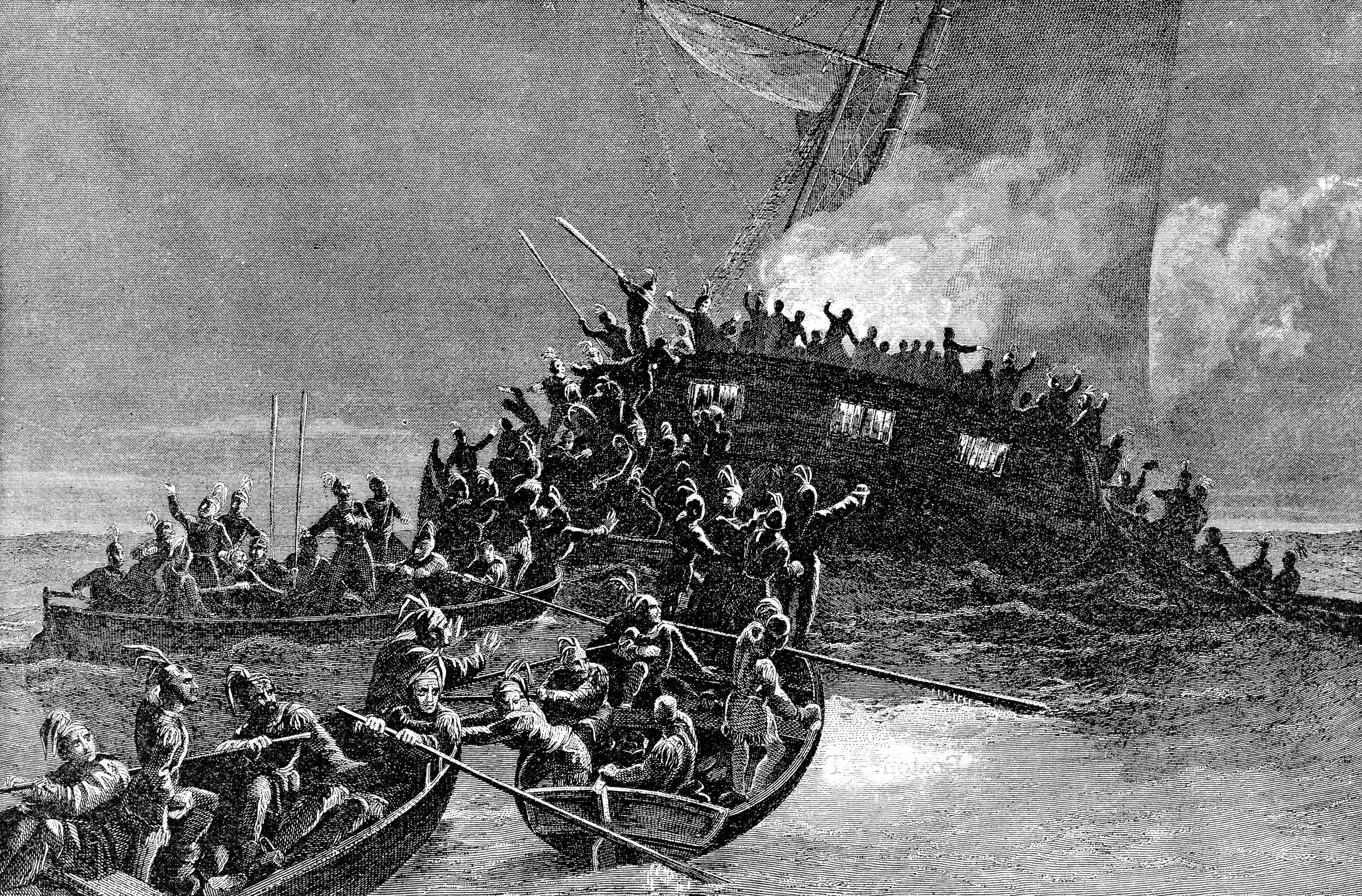
This Day in Legal History: The Burning of the Gaspee
On this day in 1772, a Royal Navy revenue schooner called HMS Gaspee, captained by a notably overzealous Lieutenant William Duddington, ran aground in shallow water in Narragansett Bay while chasing a Rhode Island packet boat called the Hannah. Within hours of the grounding, roughly sixty Providence merchants, sailors, and “Sons of Liberty” — led by John Brown, one of the wealthiest men in the colony — rowed out under cover of darkness in eight longboats, boarded the Gaspee, shot Duddington, and burned the ship to the waterline. The legal significance lies in what came next. The Crown convened a Royal Commission of Inquiry with authority to ship the perpetrators across the Atlantic for trial in England, bypassing colonial juries entirely, a procedural maneuver that the colonies read as a direct attack on the right to jury trial in the vicinage.
The Virginia House of Burgesses responded in March 1773 by forming the first Committee of Correspondence, a sustained intercolonial communication network that became, two years later, the institutional skeleton of the Continental Congress. The Gaspee Affair never produced a single prosecution — the commission could not get the colonial governor or the Rhode Island courts to cooperate, and witness testimony evaporated — but it produced something more durable: the colonial conviction that the Crown’s willingness to detour around local juries was itself a constitutional grievance worth organizing against. The right-to-jury-in-the-vicinage point that Madison wrote into the Sixth Amendment seventeen years later is, in a real sense, the Gaspee Affair’s longest-lived legacy.
The Supreme Court on Monday granted, vacated, and remanded the D.C. Circuit’s decision in American Gas Association v. Department of Energy, sending the long-disputed Biden-era Department of Energy efficiency rule on non-condensing residential gas furnaces and commercial water heaters back to the D.C. Circuit “for further consideration in light of the position asserted by the Solicitor General.” That last phrase is the operative one. The new Solicitor General, on behalf of the second Trump administration’s DOE, told the Court in late April that the prior administration’s reading of the Energy Policy and Conservation Act was, in DOE’s current view, wrong, and that the rule effectively bans non-condensing units that millions of homes and small commercial properties were built around. A confessed-error from a new administration doesn’t automatically win a case, but the procedural vehicle — a grant-vacate-remand, or “GVR” — is the Court’s standard way of saying “go look at this again with the new posture in mind” without resolving the merits itself.
The trade-group plaintiffs, led by the American Gas Association and the American Public Gas Association, framed the rule from the start as a de facto product ban dressed up as efficiency standards. The environmental and consumer groups that intervened to defend the rule will get another bite at the apple on remand, but their position is harder when their own client agency has switched sides. Watch the D.C. Circuit’s case calendar over the next few weeks for an expedited briefing schedule.
Supreme Court Vacates Decision Outlawing Gas Stoves, Water Heaters | NewsBusters
SCOTUSblog on Monday published a careful overview of an increasingly organized litigation campaign to ask the Supreme Court to overrule Obergefell v. Hodges, the 2015 decision recognizing a constitutional right to same-sex marriage. The campaign now includes Liberty Counsel, MassResistance, and the Southern Baptist Convention, which last year voted overwhelmingly to urge the Court to reverse the decision. The underlying ground for the push is partly the Court’s reasoning in Dobbs four years ago, which gave conservative litigants a road map for unwinding substantive due process precedents, and partly the gradual erosion of public-opinion support for same-sex marriage in one slice of the polling, with Republican support falling from 55 percent in 2022 to 37 percent now. The legal headcount at the Court is, however, the part of the story that is not yet there.
Only Justice Thomas has been a consistent vote to revisit Obergefell, having said so in his Dobbs concurrence. Justice Alito, despite being one of Obergefell’s original dissenters, recently emphasized in a public speech that he is not suggesting the case should be overruled, citing stare decisis. Justice Gorsuch’s dissent in 303 Creative seems to concede that Obergefell is good law and tries instead to carve out specific exceptions to it. None of which is a reason for litigants on the marriage-equality side to relax. The path Dobbs opened up is wider than any single justice’s current voting pattern, and the campaign is plainly playing a long game.
The next round of test cases on standing and ripeness will start to surface in the lower courts in the next term or two — that is when the campaign’s seriousness becomes measurable.
The campaign to overrule Obergefell | SCOTUSblog
The third and most constitutionally significant story of the day is one we’ve been watching: the litigation over President Trump’s $400 million ballroom — built on the site of the demolished East Wing — is on track to land in front of the Supreme Court, SCOTUSblog reported Monday. The D.C. Circuit panel that heard the case for more than two hours in late April has not yet ruled, but the questioning made clear that a more substantial opinion is coming and that an appeal to the Court is the likely next stop regardless of which side wins. The legal question is unusually fundamental. The plaintiff, the National Trust for Historic Preservation, argues that the President has no “free-floating” power to construct major federal buildings without an appropriation from Congress, and that the Antideficiency Act and the Public Buildings Act both require the kind of statutory authorization the East Wing ballroom never received.
The administration’s response, delivered in a tone that several court-watchers described as unusually defiant, has essentially been that construction has “gone too far to be stopped” and that the courts have no role in second-guessing a presidential building decision once the steel is up. The structural separation-of-powers questions here — what does the Appropriations Clause actually constrain, and can a federal court enjoin a President from continuing to build something that is partially constructed — are large enough that the Supreme Court will almost certainly want to take the case if it reaches the high court. Construction, meanwhile, continues. The most likely Supreme Court resolution is a narrow opinion on standing or remedies, with the broader Appropriations Clause questions deferred for another day. We will see.
White House ballroom battle may soon arrive at the Supreme Court | SCOTUSblog
In my Bloomberg Tax column this week, I argue that the SALT deduction cap’s biggest problem is not that it is unconstitutional, but that it is badly designed. The latest failed challenge, Sims v. United States, involved two New Jersey taxpayers who claimed the cap violated the 10th Amendment, the 16th Amendment, and broader federalism principles. The federal district court rejected those arguments, finding that Congress has broad authority to tax income and decide which deductions are allowed, limited, or denied. My point is that opponents of the SALT cap should stop looking for constitutional defects that courts are unlikely to find and instead focus on forcing Congress to fix the policy it created.
I explain that the cap has always been politically loaded: supporters see it as a needed limit on a deduction that benefits many high-income taxpayers in high-tax states, while critics see it as a targeted attack on those states. But unfair or politically motivated tax policy is not automatically unconstitutional. The real weakness, I argue, is the cap’s uneven design, especially the pass-through entity tax workaround. Many business owners can effectively get around the cap when state taxes are paid at the entity level, while wage earners, sole proprietors, and many individual taxpayers remain stuck behind it.
That creates a serious mismatch: two taxpayers can live in the same state, earn similar income, and face similar state tax burdens, but receive different federal treatment depending on whether one has the right business structure. I argue that this kind of selective relief may be a more promising target for a narrower administrative or legal challenge than another broad constitutional attack on Congress’s taxing power. Congress partly recognized the problem when it raised the cap from $10,000 to $40,000, but I note that the fix is temporary, only lightly indexed, and still leaves major structural problems in place. The marriage penalty remains especially glaring because married couples filing jointly do not receive double the cap available to similarly situated unmarried taxpayers.
I also criticize the phaseout design because it can create cliffs or marginal-rate spikes that reward tax gamesmanship rather than sound policy. A better fix, in my view, would make the higher cap permanent, index it meaningfully, eliminate the marriage penalty, smooth out the phaseout, and require Treasury to rationalize the treatment of pass-through entity taxes. The lesson from Sims is that courts may uphold the SALT cap, but that does not make it good tax policy. If the cap is unfair, incoherent, or selectively porous, Congress owns that problem.
SALT Deduction Cap Falls Short in Design, Not Constitutionality


