



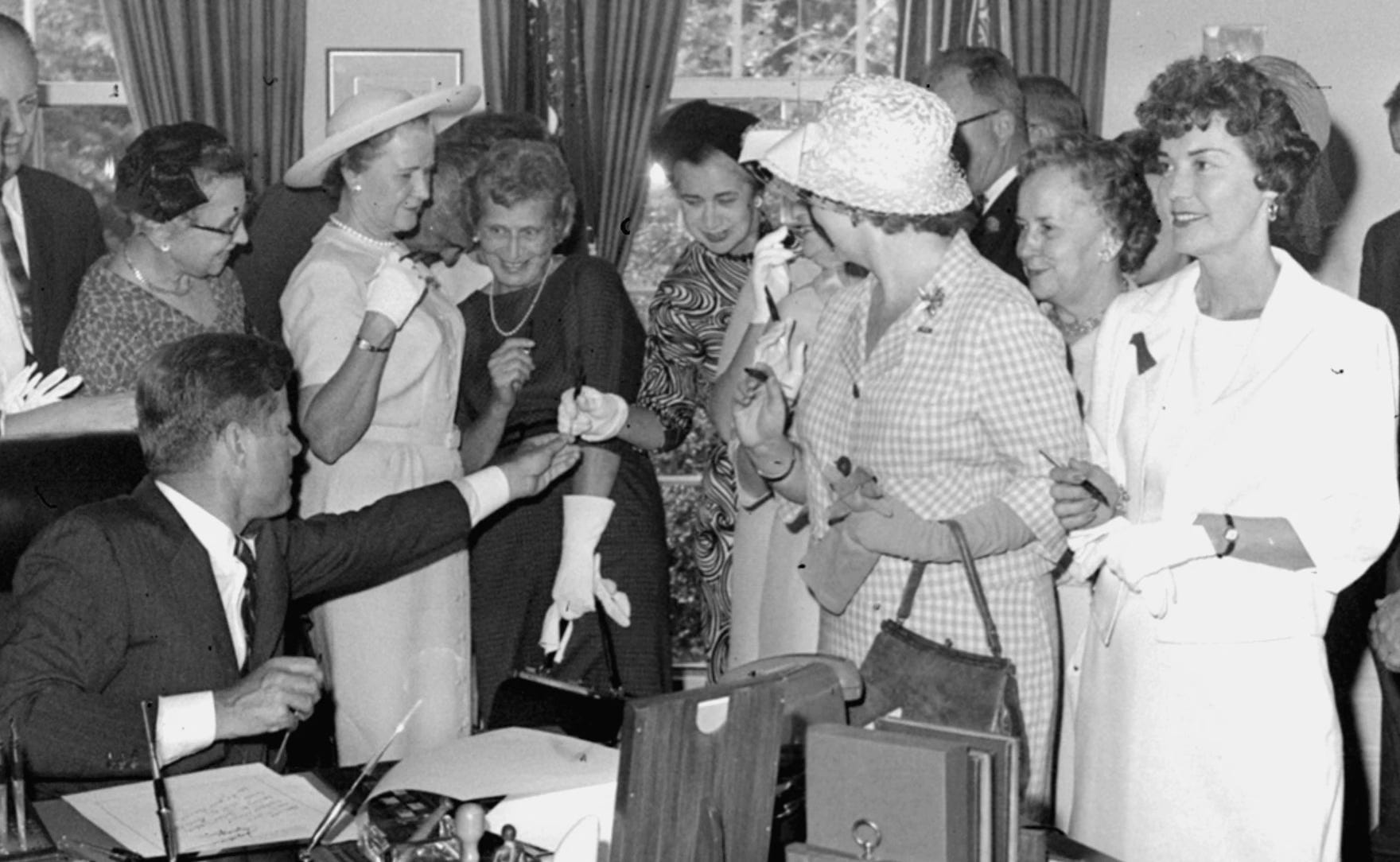
This Day in Legal History: Kennedy Signs the Equal Pay Act
On this day in 1963, President John F. Kennedy signed the Equal Pay Act, the first federal statute aimed directly at sex-based wage discrimination. The law took the form of an amendment to the Fair Labor Standards Act of 1938, which meant that it slid into an existing enforcement framework run by the Wage and Hour Division of the Department of Labor — a deliberate choice that bypassed the need to build new institutional machinery and harnessed thirty years of FLSA caselaw and habits of compliance. The legal hook is the Act’s “equal pay for equal work” command: employers may not pay employees of one sex less than employees of the opposite sex for jobs requiring “equal skill, effort, and responsibility, and which are performed under similar working conditions.”
Four affirmative defenses are written into the text — a seniority system, a merit system, a system measuring earnings by quantity or quality of production, or “any other factor other than sex” — and that fourth catch-all has done more work in litigation than the other three combined, shaping how courts evaluate market-based, education-based, and prior-salary-based pay differentials decades later. The wage gap at the moment Kennedy signed was about 59 cents on the dollar; six decades on, by the Bureau of Labor Statistics’s standard measure, it sits closer to 84 cents. That tells you something about how a clean, structurally well-designed statute can still leave a lot of the work undone, because the gap is and always was about more than identical pairs of jobs at the same employer.
The Equal Pay Act is not the whole story of American workplace-equality law; Title VII of the Civil Rights Act of 1964, the Pregnancy Discrimination Act, the Lilly Ledbetter Fair Pay Act, and a long line of state-law analogues do much of the modern enforcement work. But June 10, 1963 is the day Congress, with the President’s signature, said for the first time that paying a woman less than a man for the same work was unlawful, full stop. Everything that has followed in this corner of the law has been built on top of that sentence.
The Federal Circuit on Monday affirmed a Delaware district court judgment invalidating four Purdue Pharma patents covering an abuse-deterrent, low-toxicity version of the opioid OxyContin, in a decision the patent bar has been waiting on for months. The case is Purdue Pharma L.P. v. Epic Pharma LLC. The patents covered Purdue’s reformulation of OxyContin to make the pills crush-resistant and to reduce a manufacturing impurity, and the asserted innovation grew, the company said, out of its discovery of the source of a particular toxic impurity that had previously eluded chemists at competing labs. Purdue’s argument on appeal was, in essence, that the discovery of the impurity’s source was itself nonobvious, and that the resulting patents inherited that nonobviousness. The Federal Circuit said no.
The panel held that the relevant obviousness inquiry asks whether the claimed reformulation — not the discovery that motivated it — would have been obvious to a person of ordinary skill in the art at the time of the invention, and that once the prior art is taken into account, the answer is yes. The practical consequence of the ruling is large. It opens the door wider for generic abuse-deterrent OxyContin alternatives and clarifies a doctrinal point pharmaceutical companies have been pressing on for years: a hard-won research insight does not, on its own, automatically save a patent from obviousness if the resulting product was within the prior art’s reach. Purdue’s options now are a rehearing petition at the Federal Circuit, a cert petition at the Supreme Court (which the company has already pursued in a related case last spring), or quiet acceptance. Expect a cert petition. Expect the cert petition to be denied. Watch the generic-drug filings that follow.
Fed. Circ. Panel Backs Invalidation Of OxyContin Patent
The plaintiffs in the Eastern District of Virginia lawsuit over the Trump administration’s $1.8 billion “Anti-Weaponization Fund” — a story we covered earlier htis week— went back to Judge Leonie Brinkema on Tuesday and asked for permission to conduct limited discovery into whether the Justice Department’s recent representation that it would stop work on the fund is a real commitment or a litigation convenience.
The plaintiffs’ problem is straightforward: acting Attorney General Todd Blanche has filed papers saying the program is “not going forward,” but President Trump publicly described the fund last week as a “great idea” that many Republicans support, and the executive order that created the fund has not been formally rescinded. From a litigation-strategy standpoint, the plaintiffs do not want to walk away from a live case on the strength of a DOJ filing, accept dismissal as moot, and then find out three months later that the fund has been quietly resurrected under a different name.
Judge Brinkema has a hearing scheduled for Friday, June 12, on whether to extend the temporary restraining order into a preliminary injunction. The Tuesday filing teed up the broader mootness fight that will dominate Friday’s hearing: when does a federal agency’s promise to stop doing something actually deprive a court of jurisdiction to enjoin the underlying program, and what discovery, if any, is a plaintiff entitled to before that determination is made. The doctrine here — voluntary cessation, capable of repetition yet evading review, and the heavy burden the Supreme Court has placed on the party claiming mootness — favors the plaintiffs procedurally. Whether Brinkema agrees on Friday is the question to watch.
‘Anti-weaponization’ fund challengers question its demise – Roll Call
SCOTUSblog’s John Elwood walked through a useful relist roundup on Tuesday, and the four cases sitting in the relist pile are worth flagging because each of them touches a different load-bearing wall in federal practice. The first is a prolonged-detention challenge to immigration custody under Section 1226(c). The ACLU is asking the Court to clarify that very long mandatory-detention periods trigger procedural due process review under the Mathews v. Eldridge balancing test, picking up on the Second Circuit’s willingness to do so. The second is Newberry v. Texas, a case where Texas itself has confessed error — a rare procedural posture in which the State agrees the defendant should win — and the question is what the Court does when the parties on both sides ask for the same remedy. The third is Kian v. Florida, a Sixth Amendment challenge to the use of six-person juries in serious felony cases, on the theory that the historical understanding of “jury” in the founding era assumed twelve and that the Court’s mid-twentieth-century cases approving six-person juries were wrong on the originalist analysis. The fourth is Maxwell v. Thomas, a federal habeas case asking whether the First Step Act‘s halfway-house and home-confinement provisions are properly enforceable through 28 U.S.C. § 2241 habeas petitions, an issue with a real circuit split. None of these have been granted yet — they are relists, which means at least one Justice is interested but the Court has not yet decided whether to hear them — but the mix is the part to watch: it tells you what the Justices are circling without committing to. Expect at least one of these to be granted before the term ends.


